Short answer: The current US Jinko solar panel datasheet set is on Jinko’s Download Center: EAGLE G7B (615–640W), EAGLE G6B and EAGLE G6X (580–600W), and EAGLE G6R (420–440W). Global Tiger Neo 78HL4-BDV sheets, including a second 620W and the 645W, sit on jinkosolar.com, and the wattage on a quote is not enough to pick the file.
Updated: November 2026.
The tables below attach a full model code to each searched wattage, line up the STC numbers, and put the US Authorized Distributor warranty (DG V6.0) next to those codes.
Which Jinko datasheet matches the panel in your quote or on your roof?
Match the full code on the back label. A searched wattage of 620W or 630W hits two modules, with different cell counts, voltages and lengths.
| Searched wattage | Model code | Series | Datasheet file | Host | Status |
|---|---|---|---|---|---|
| 470W | JKM470M-7RL3-TV | EAGLE 78TR G4b, tiling ribbon | JKM455-475M-7RL3-TV-A3-US, uploaded Nov 2020 | jinkosolar.us | Archived US |
| 585W | JKM585N-72HL4-BDV | EAGLE G6B | JKM580-600N-72HL4-BDV-F30R-F3-US, 2024 | jinkosolar.us | Current US |
| 590W | JKM590N-72HL4-BDV | EAGLE G6B | Same F30R-F3-US file | jinkosolar.us | Current US |
| 620W bifacial | JKM620N-66HL4M-BDV | EAGLE G7B | JKM615-640N-66HL4M-BDV-F1-US, Sep 2025 | jinkosolar.us | Current US |
| 620W bifacial | JKM620N-78HL4-BDV | Tiger Neo, global | JKM605-625N-78HL4-BDV-F5-EN (page title inside the file reads F4-EN) | jinkosolar.com | Global |
| 630W | JKM630N-66HL4M-BDV | EAGLE G7B | Same F1-US file as the US 620W | jinkosolar.us | Current US |
| 630W | JKM630N-78HL4-BDV | Tiger Neo, global | JKM625-650N-78HL4-BDV-F9-EN, 9 Jan 2025 | jinkosolar.com | Global |
| 645W | JKM645N-78HL4-BDV | Tiger Neo, global | Same F9-EN file | jinkosolar.com | Global |
Read the code in four pieces. The digits after JKM are the STC watt class. N marks the N-type sheets in this set (TOPCon on the G6B, G7B and F9 files); the 470W G4b code uses M. The middle token is the cell count: 72HL4 is 144 half cells, 66HL4M is 132, 78HL4 is 156, and the G6R’s 54HL4 is 108 half cells. BDV is the bifacial suffix on these rows. The file tail (F30R-F3-US, F1-US, F5-EN, F9-EN, A3-US) is the revision. Check the suffix.
The global 605–625W PDF is the easy one to misfile. The file name says F5-EN. The embedded page title reads F4-EN. Treat that pair as one sheet, then confirm the label says JKM620N-78HL4-BDV and not the US 66HL4M code.
G6X is a separate current US sheet in the same 580–600W band as G6B. If a label says G6X, open the G6X sheet itself rather than using the G6B numbers further down. The Tiger Neo page is the one to open when the code is 78HL4-BDV and you still need the series, not just the wattage.
What are the specs on the Jinko 585W, 590W, 620W, 630W, 645W and 470W datasheets?
STC figures below come from the file named in the last column. Blank cells are values that file extract did not include. The 580W bin on the G6B sheet, JKM580N-72HL4-BDV, is on the 580W page. The rest of the current US catalog is on the model catalog.
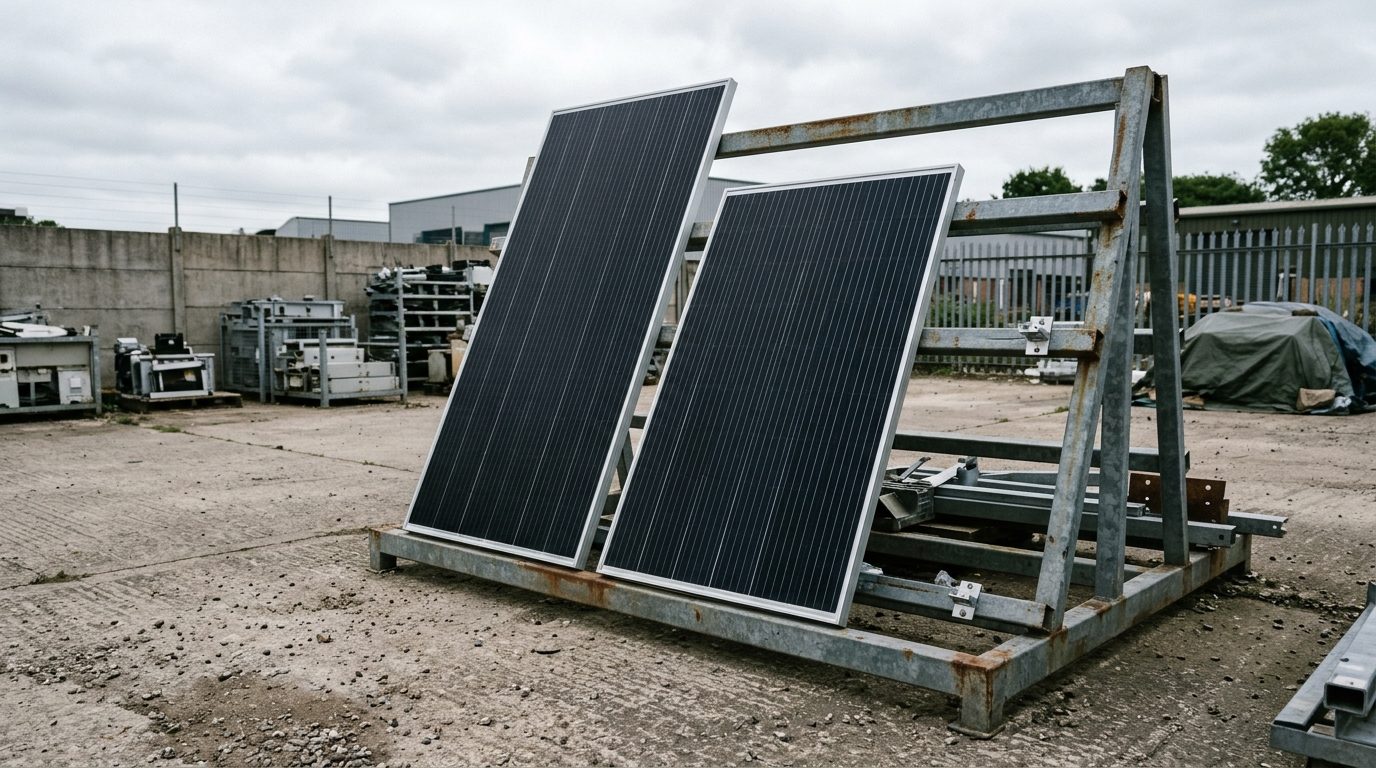
| Model | Pmax (W) | Vmp (V) | Imp (A) | Voc (V) | Isc (A) | Efficiency (%) | Size (mm) | Weight | Max series fuse (A) | Max system voltage (VDC) | Pmax temp. coeff. (%/°C) | Bifacial factor | Datasheet |
|---|---|---|---|---|---|---|---|---|---|---|---|---|---|
| JKM585N-72HL4-BDV | 585 | 44.02 | 13.29 | 52.70 | 14.01 | 22.65 | 2278 × 1134 × 30 (89.69 × 44.65 × 1.18 in) | 31 kg (68.34 lb); file also lists 32 kg (70.55 lb) | 30 | 1500 | −0.29 | 80±5% | EAGLE G6B F30R-F3-US |
| JKM590N-72HL4-BDV | 590 | 44.17 | 13.36 | 52.90 | 14.07 | 22.84 | same as JKM585N | same as JKM585N | 30 | 1500 | −0.29 | 80±5% | EAGLE G6B F30R-F3-US |
| JKM600N-72HL4-BDV | 600 | 44.45 | 13.50 | 53.30 | 14.19 | 23.23 | same as JKM585N | same as JKM585N | 30 | 1500 | −0.29 | 80±5% | EAGLE G6B F30R-F3-US |
| JKM620N-66HL4M-BDV | 620 | 40.74 | 15.22 | 49.08 | 16.08 | 22.95 | 2382 × 1134 × 30 (93.77 × 44.65 × 1.18 in) | 32.4 kg (71.42 lb) | 35 | 1500 | 80±5% | EAGLE G7B F1-US | |
| JKM620N-78HL4-BDV | 620 | 45.93 | 13.50 | 55.58 | 14.19 | 22.18 | 2465 × 1134 × 30 (97.05 × 44.65 × 1.18 in) | 34.6 kg (76.38 lb) | 30 | 1500 (IEC) | −0.29 | Tiger Neo F5-EN | |
| JKM630N-66HL4M-BDV | 630 | 41.02 | 15.36 | 49.48 | 16.20 | 23.32 | same as US 620W G7B | 32.4 kg (71.42 lb) | 35 | 1500 | 80±5% | EAGLE G7B F1-US | |
| JKM630N-78HL4-BDV | 630 | 47.70 | 13.21 | 57.08 | 13.86 | 22.54 | 2465 × 1134 × 30 | 34.0 kg | 30 | 1500 (IEC) | Tiger Neo F9-EN | ||
| JKM645N-78HL4-BDV | 645 | 48.17 | 13.39 | 57.47 | 14.04 | 23.07 | 2465 × 1134 × 30 | 34.0 kg | 30 | 1500 (IEC) | Tiger Neo F9-EN | ||
| JKM470M-7RL3-TV | 470 | 43.44 | 10.82 | 52.10 | 11.53 | 20.65 | 2205 × 1032 × 40 (86.81 × 40.63 × 1.57 in) | 26.5 kg (58.42 lb) | 25 | 1500 | −0.35 | 70±5% | EAGLE 78TR G4b A3-US |
Use the row whose model code is on the label. The two 630W modules are a string mismatch if someone mixes them: Voc is 49.48 V on the US G7B and 57.08 V on the global F9 sheet, and Imp is 15.36 A against 13.21 A. The two 620W modules split the same way. US G7B Voc is 49.08 V and the module is 2382 mm long, with a 35 A series fuse. Global F5 Voc is 55.58 V, the module is 2465 mm long, and the series fuse rating is 30 A.
On weight, trust a check against the module you received for the G6B. Per the EAGLE G6B datasheet, one section lists 31 kg (68.34 lb) and another lists 32 kg (70.55 lb).
The G7B sheet also lists fire Type 29 and design loads of 5400 Pa front and 2400 Pa rear. The F9 sheet lists those same loads, plus IEC 61215:2021 and IEC 61730:2023. The G6B sheet lists fire Type 29 and UL 61730, IEC 61215 and IEC 61730. The G4b 470W sheet is the short, 40 mm frame in this set: 2205 × 1032 mm, 25 A fuse, bifacial factor 70±5%.
How do you read STC, BNPI and the temperature coefficients?
STC on these sheets is the nameplate test point: 1000 W/m² at a 25°C cell temperature. Pmax, Vmp, Imp, Voc and Isc in the table are STC values. NOCT on the G6B sheet is 45±2°C. Compare modules on STC. Apply the temperature coefficients when the cell is not at 25°C.
BNPI is the bifacial nameplate, front 1000 W/m² plus rear 135 W/m². On the F9-EN sheet the 645W model reads 710W at BNPI. That 710W figure is a bifacial test point. It is not the 645W STC nameplate, and it is not the warranted power number in the next section.
The G6B sheet lists power tolerance as 0 to +3%. A JKM590N from that sheet can leave the factory as high as 3% over 590W. Pmax moves −0.29%/°C on the G6B sheet and on the global F5 sheet. The archived G4b 470W sheet uses −0.35%/°C. On the G6B sheet, Voc moves −0.25%/°C and Isc moves +0.045%/°C.
Cold weather pushes Voc up. Take the JKM590N-72HL4-BDV at a cell temperature of −10°C. STC Voc is 52.90 V at 25°C, and the Voc coefficient on the G6B sheet is −0.25%/°C. The cell is 35°C below the STC temperature, so voltage rises:
52.90 × (1 + 0.0025 × 35) = 52.90 × 1.0875 = 57.53 V.
That is a straight-line estimate for a string-voltage check. The datasheet does not publish a measured Voc at −10°C.
F30R-F3-US, F1-US, F9-EN and A3-US name the file version. A loose PDF with a different tail is a different revision. Match it to the code on the label before you drop a voltage into an inverter worksheet.
How long is the Jinko solar panel warranty?
Under the US Authorized Distributor warranty, DG V6.0 (file dated 06/26/2025), the product warranty is 12 years (144 months) for most module types and 25 years (300 months) for three black-frame, black-backsheet groups. The power term is 25 or 30 years by generation. G6 and G7 are 30 years.
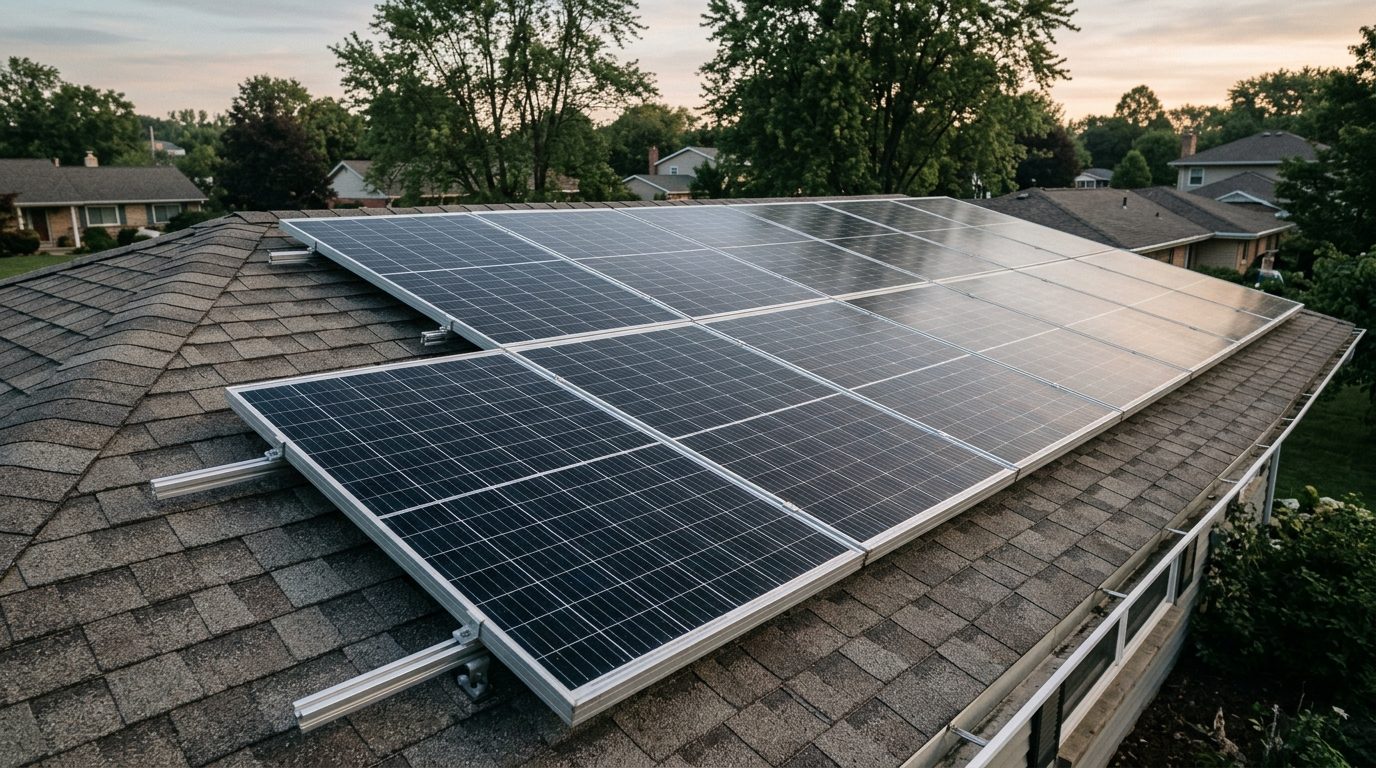
DG V6.0 covers modules Jinko or its affiliates sold to an Authorized Distributor on or after January 1, 2025. That distributor group includes companies on Jinko’s authorized US distributor list and residential installers who buy directly from Jinko. The customer is “any end-user of Modules.”
| Generation | Product warranty (years) | Year-1 degradation (%) | Annual degradation after year 1 (%) | Power term (years) | Minimum output at end of term (%) |
|---|---|---|---|---|---|
| G2 | 25 for black frame and black backsheet; 12 otherwise | 2.5 | 0.6 | 25 | 83.1 |
| G3 bifacial | 12 | 2.5 | 0.55 | 30 | 81.55 |
| G4 | 25 for 66-cell black frame and black backsheet; 12 otherwise | 2.0 | 0.55 | 25 | 84.80 |
| G4b | 12 | 2.0 | 0.45 | 30 | 84.95 |
| G5 | 12 | 2.0 | 0.55 | 25 | 84.80 |
| G5b | 12 | 2.0 | 0.45 | 30 | 84.95 |
| G6 | 25 for 54-cell black frame and black backsheet; 12 otherwise | 1.0 | 0.40 | 30 | 87.40 |
| G7 | 12 | 1.0 | 0.40 | 30 | 87.40 |
All eight rows are DG V6.0. The product warranty is freedom from “material defects in design, materials and workmanship that affect the performance of the Module.” The 25-year product group is G2 black frame/black backsheet, G4 66-cell black frame/backsheet, and G6 54-cell black frame/backsheet.
The EAGLE G6R datasheet (JKM420-440N-54HL4-B-R-F2-US, August 2023) states that same pairing for its own modules: a 25-year product warranty and a 30-year linear power warranty, 1% or less in year 1, 0.4% or less each year after, and at least 87.4% at year 30. The JKM440N-54HL4-B line on that sheet is 440W, Voc 39.57 V, Isc 13.80 A, efficiency 22.53%, 108 half cells, 1722 × 1134 × 30 mm (67.79 × 44.65 × 1.18 in), 22 kg (48.50 lb). Max system voltage on the G6R sheet is 1000 VDC, and the max series fuse is 25 A. The G6B and G7B sheets are 1500 VDC. Keep the G6R on its own inverter input limit.
Jinko’s US homeowner page, seen November 2026, still says “The solar panels come with a standard 25-year power warranty” and tells homeowners to call their distributor. The same page still says the residential tax credit “steps down to 22% in 2023.” For a G6 or G7 module sold under DG V6.0, the power term in the warranty PDF is 30 years, down to 87.40%.
The G6B and G7B datasheets print the same 12-year product and 30-year power line (≤1% in year 1, ≤0.4%/yr after, ≥87.4% at year 30). The archived G4b 470W sheet prints 12 years product and 30 years power, ending at 84.95%.
How much power does Jinko guarantee after 10, 25 and 30 years?
For a 590W G6B, both DG V6.0 (the G6 row) and the G6B datasheet use 1.0% in year 1 and 0.4% per year after that. The warranty applies to front-side output. Start from the 590W STC nameplate on JKM590N-72HL4-BDV.
Year 10 drops the first-year 1.0% and nine further years at 0.4%: 100 − 1.0 − (9 × 0.4) = 95.4%. 590 × 0.954 = 562.86 W.
Year 25 uses twenty-four years after year 1: 100 − 1.0 − (24 × 0.4) = 89.4%. 590 × 0.894 = 527.46 W.
Year 30 uses twenty-nine years after year 1: 100 − 1.0 − (29 × 0.4) = 87.4%. 590 × 0.874 = 515.66 W.
| Year | Remaining share of 590W | Warranted minimum front-side power (W) |
|---|---|---|
| 10 | 95.4% | 562.86 |
| 25 | 89.4% | 527.46 |
| 30 | 87.4% | 515.66 |
The year-30 result, 87.4%, is the G6 minimum printed in DG V6.0. G7 uses the same percentages. A G4b module does not: that row is 2.0% in year 1 and 0.45% a year after, to 84.95% at year 30.
On bifacial modules, DG V6.0 says “the Limited Power Warranty for bifacial Modules shall apply only to the front-side power output” and “Jinko makes no representations or warranty with respect to the back-side power output.” Rear gain can be real on the roof. It is outside this warranty. A low-output claim is measured against the front-side STC watts, not against the 710W BNPI line.
What voids a Jinko warranty?
DG V6.0 withholds both warranties in the cases below. The left column tracks the warranty’s own list.
| Exclusion in DG V6.0 | What it means for a homeowner |
|---|---|
| Altered, repaired or modified without Jinko’s prior written consent | A repair or a change made before Jinko agrees in writing |
| “removed and re-installed at any location other than the physical location in which it was originally installed” | The module leaves the building where it was first installed |
| Misused, abused, neglected, or in an accident | Damage the warranty puts under misuse, neglect or an accident |
| Force majeure, surges, lightning, flood, fire, vandalism, or accidental breakage | Surge, lightning, flood, fire, vandalism, or glass broken by accident |
| Installed on mobile platforms other than single- or dual-axis trackers, or in a marine environment | A vehicle or a boat. A single- or dual-axis tracker at the original site is the exception written in the warranty |
| Exposed to corrosive agents, salt water, or pests | Corrosive agents, salt water, and pests are each named |
| Installed or used inconsistently with the Jinko Installation Manual | Mounting or wiring that does not follow Jinko’s installation manual |
| Type or serial labels altered, removed, or illegible | The label is missing, changed, or cannot be read |
| Jinko has not received full payment | The module was not paid for in full to Jinko |
A tracker is allowed. A second address is not. Keep the label readable, because a missing serial also stops the claim file in the next section.
What does the Jinko warranty not pay for?
Jinko does not pay labor to remove or reinstall the panel. DG V6.0 states: “IN NO EVENT SHALL JINKO BE RESPONSIBLE PURSUANT TO THIS WARRANTY FOR ANY PERFORMANCE ANALYSIS, INSPECTION, DIAGNOSIS, REMOVAL, REINSTALLATION COSTS.”
The remedy in that warranty is a replacement module: “Replacement Modules shall be delivered to the Authorized Distributor at Jinko’s sole cost.” Jinko’s Warranty Claim Process and Evidence Required document (v09.14.26) describes the remedy as “either a credit memo to the entity that placed the PO for purchase or a replacement module,” if a same or similar module is in stock. Those are two Jinko documents. One names delivery of a replacement to the distributor. The other also allows a credit memo to the buyer on the purchase order. Neither document pays the crew on the roof.
Back-side output is outside the power warranty, as the sentence in the previous section says. The warranty is governed by California law. Disputes go to AAA Consumer Arbitration. There is no dedicated transfer clause in DG V6.0.
How do you file a Jinko warranty claim?
File while the labels are still readable, and file within 30 days of learning of the problem. Jinko’s EAGLE modules page tells owners to contact their installer first. Direct purchasers, and owners who cannot reach the installer, use the Warranty Claim Form, file 20260622-Jinko-Claim-Form-v12 (June 2026).
- Notify Jinko promptly, and not later than 30 days after you know about the problem. DG V6.0 sets that deadline and the mailbox, [email protected], and it requires the serial number in the notice.
- Fill in the Excel claim form, v12, June 2026. The claim-process document is the evidence checklist that goes with it.
- Enter the serial numbers. Each serial is 24 digits and letters. The claim-process document says “WE DO NOT PROCESS CLAIMS WITHOUT SERIAL NUMBERS.” It also says “Claims without photos of the Serial Number label will also not be processed.”
- Photograph each module: the front, including the array; the back, including wire management; the nameplate; and the serial label in three places (upper left beneath the glass, the middle of the back, and the long side edge).
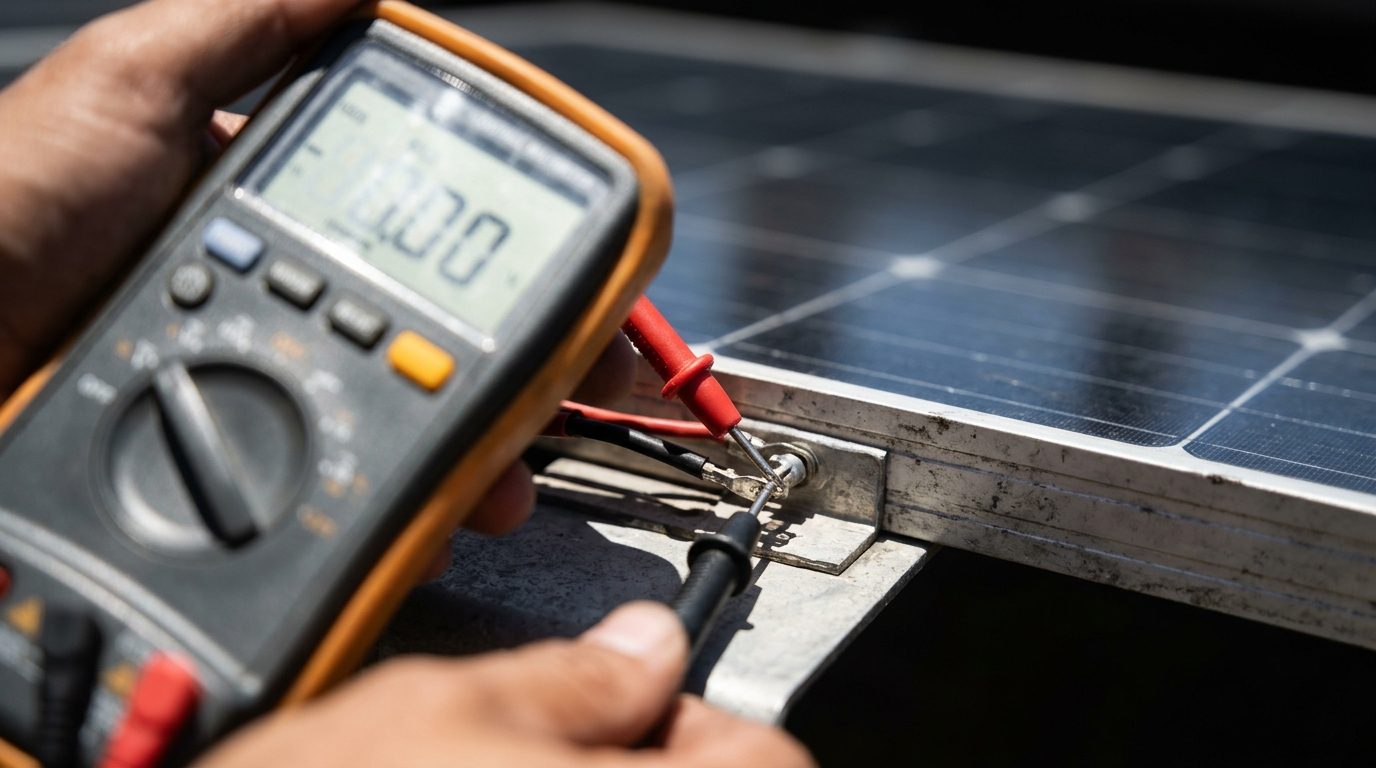
- Take a multimeter DC Voc reading at the module connector leads, not at the MLPE. The module faces the sun, near midday.
- Above six modules, the claim needs an upload link.
A low-performance claim needs a one-third reduction from the STC Voc printed on the back label. Jinko’s own example: a 320W module with STC Voc of 40.9 V is low under 27 V. Apply the same cut to the JKM590N. STC Voc is 52.90 V on the G6B sheet. Two-thirds of 52.90 V is 35.27 V. A reading below about 35.27 V is the threshold that example describes.
Low-performance claims also need monitoring screenshots from the original location, and again after the module is moved to an adjacent position or to an MLPE. Manufacture date, if you need it for the warranty start, is digits 7–12 of that same 24-character serial (YYMMDD).
Which Jinko warranty version applies to your panels?
The file that applies is the one in force for that sale, not whichever PDF is newest on the day you claim.
| Document | Which modules | Terms that differ from the tables above |
|---|---|---|
| Authorized Distributor (DG) Warranty V6.0, file 06/26/2025 | Sold by Jinko or its affiliates to a US authorized distributor on or after January 1, 2025 | Product and power table in this page. Customer means any end-user. |
| Seller’s Limited Module Warranty (Utility), effective July 2024 | Tied to a Project Module Supply Agreement | 12-year (144-month) product warranty for all types. The buyer “shall bear the burden of establishing a breach.” Jinko may require a test at an independent lab such as TÜV Rheinland or TÜV SÜD, and that finding is final. Remedies are repair, replacement or additional modules; Jinko pays shipping; remedies “shall not extend the term of any Warranties.” The warranty “may be assigned in whole but not in part.” |
| Archived module warranties on the US Download Center | Older arrays | Versions run back to “Effective Before 05/2014.” |
DG V6.0 starts the warranties “one hundred and eighty (180) days following the Module manufacture date.” Read that date from digits 7–12 of the serial number, as YYMMDD. A module built on 15 March 2025 (250315 in those digits) starts its warranty clock 180 days later. The calendar day of installation is not the trigger in this version.
A utility project and a distributor pallet can sit in the same neighborhood under different documents. Ask which agreement the serial shipped under before you quote a 30-year G6 number at a project owner. The July 2024 utility warranty is a different document from DG V6.0.
For a G4, G4b or G5 array, a replacement module often will not match the old frame. The 470W JKM470M-7RL3-TV is 2205 × 1032 × 40 mm, with Voc 52.10 V. Current G6B modules are 2278 × 1134 × 30 mm. Check fit and string voltage on the discontinued models page before you accept a substitute.
Questions that decide a claim
Is the Jinko warranty 25 or 30 years?
For G6 and G7 under DG V6.0, the power warranty is 30 years, to 87.40% of front-side nameplate. The product warranty on those generations is 12 years, except the G6 54-cell black-frame/black-backsheet modules, which get 25 years product. G4 (non-b) and G5 power terms are 25 years, to 84.80%. Jinko’s homeowner page still says a standard 25-year power warranty. Use the PDF for the sale date, not that sentence.
Does the Jinko warranty cover labor?
No. DG V6.0 puts performance analysis, inspection, diagnosis, removal and reinstallation costs outside Jinko’s obligation. The stated remedy is a replacement module delivered to the authorized distributor at Jinko’s cost. The claim-process document also allows a credit memo to the entity that placed the purchase order, when a same or similar module is in stock.
Is the Jinko warranty transferable if you sell the house?
DG V6.0 gives the warranties to “any end-user of Modules.” It has no dedicated transfer clause. It voids coverage if a module is “removed and re-installed at any location other than the physical location in which it was originally installed.” Selling the house is not given its own sentence. Moving the panels is. The July 2024 utility warranty is a separate contract, and that one “may be assigned in whole but not in part.”
Where is the serial number on a Jinko panel?
The claim-process document requires a photo of the serial label in three places: upper left beneath the glass, the middle of the backside, and the long side edge. The serial is 24 characters. Digits 7–12 are the manufacture date, YYMMDD, which is what you use for the 180-day warranty start under DG V6.0.
Check on your quote
- Match the full model code on the label. A 620W line can be JKM620N-66HL4M-BDV (US G7B, Voc 49.08 V, 2382 mm, 35 A fuse) or JKM620N-78HL4-BDV (global Tiger Neo F5, Voc 55.58 V, 2465 mm, 30 A fuse).
- Read the revision on the PDF. F30R-F3-US, F1-US, F9-EN and A3-US are different files. On the global 605–625W PDF the file name says F5-EN and the page title inside says F4-EN.
- Ask which warranty the pallet shipped under. DG V6.0 is for modules sold to a US authorized distributor on or after January 1, 2025. A project can sit under the July 2024 utility warranty instead, with a 12-year product term for every type.
- On any BDV module, count only front-side watts toward the power warranty. The 710W BNPI figure on the 645W F9 sheet is not a warranted output.
- On a G4, G4b or G5 roof, including the 470W JKM470M-7RL3-TV, compare the replacement’s length, frame thickness and Voc with the module coming off before you pay for the swap.