Short answer: The current Jinko 580W solar panel is the Tiger Neo JKM580N-72HL4-BDV: n-type, 144 half cells, bifacial dual glass, 2278×1134 mm, 22.45% efficient, rated 1500 V. Check the suffix before you pay. The US EAGLE G6B, the monofacial JKM580N-72HL4-(V), and the 2020 p-type Tiger Pro JKM580M-7RL4-V are also sold as 580 W, and the voltages do not match.
Updated: November 2026
The 580 W codes do not share one voltage block. Open-circuit voltage on the current n-type sheets is 51.02 V, 51.47 V, or 52.50 V. The old Tiger Pro sits higher.
Which Jinko 580W panel is in your quote?
The Jinko 580W on a quote is whichever full JKM code is printed. Read the suffix, then the datasheet revision. Two sheets titled 72HL4-BDV publish different volts and amps.
| Code on the quote | Series | Cell type | Faces | Size (mm) | Where it shows up |
|---|---|---|---|---|---|
| JKM580N-72HL4-BDV | Tiger Neo, global F6 | n-type | bifacial dual glass | 2278×1134×30 | Global F6 sheet, September 2023 |
| JKM580N-72HL4-BDV-F30R | Tiger Neo, US EAGLE G6B | n-type | bifacial dual glass | 2278×1134×30 | US 30 mm F3-US sheet |
| JKM580N-72HL4-(V) | Tiger Neo monofacial | n-type | monofacial | 2278×1134×30 or 35 | Global (V) sheets |
| JKM580M-7RL4-V | Tiger Pro | p-type mono | monofacial | 2411×1134×35 | Launched 2020 |
580 is the wattage. N is n-type and M is p-type mono. 72HL4 is the half-cut format: 144 half cells (2×72). 7RL4 is the Tiger Pro format: 156 p-type cells. The May 2020 launch called that 580 W module 78TW. BDV is bifacial dual glass. (V) is monofacial. F30R is the extra suffix on the US 30 mm EAGLE G6B.
Jinko’s US downloads also list an EAGLE G6X, JKM580-600N-72HL4-BDX, a 580–600 W bifacial dual-glass module with extreme-weather glass. A quote that says BDX needs the G6X sheet. Letter-by-letter decoding, and the current US lineup that includes the G6B 580–600 W, is on the JKM code legend.
What are the JKM580N-72HL4-BDV specs?
The global F6 module and the US EAGLE G6B module share 580 W, 22.45% efficiency, a 2278×1134×30 mm outline, and a 30 A series fuse. They do not share voltage or current.
| Spec | Global F6 | US G6B F30R |
|---|---|---|
| Pmax (W) | 580 | 580 |
| Vmp (V) | 42.59 | 43.88 |
| Imp (A) | 13.62 | 13.22 |
| Voc (V) | 51.47 | 52.50 |
| Isc (A) | 14.37 | 13.95 |
| Efficiency (%) | 22.45 | 22.45 |
| Pmax temp. coefficient (%/°C) | −0.29 | −0.29 |
| Voc temp. coefficient (%/°C) | −0.25 | −0.25 |
| Isc temp. coefficient (%/°C) | +0.045 | +0.045 |
| Dimensions (mm) | 2278×1134×30 | 2278×1134×30 |
| Weight (kg) | 32 | 31 |
| Weight (lb) | 70.55 | 68.34 |
| Series fuse (A) | 30 | 30 |
The F6 column is Jinko’s F6 datasheet (September 2023): 144 n-type mono half cells, power tolerance 0 to +3%, about 436 Wp at NOCT, 89.69×44.65×1.18 in, 1500 VDC maximum system voltage, bifaciality 80±5%, 2400 Pa wind load, and 5400 Pa snow load. The US column is the EAGLE G6B F3-US datasheet (posted September 2024). For an F30R pallet, take maximum system voltage, bifaciality, and the load ratings from that PDF. The two Imp values, 13.62 A and 13.22 A, belong on separate MPPT inputs.
The monofacial JKM580N-72HL4-(V), on Jinko’s 565–585 W F4 sheet, is a third 580 W n-type module: Vmp 42.37 V, Imp 13.69 A, Voc 51.02 V, Isc 14.47 A, efficiency 22.45%. It measures 2278×1134×35 mm and weighs 28 kg (61.73 lb). Maximum system voltage is listed as 1000/1500 VDC, and the series fuse is 25 A. A later 580–605 W (V) sheet lists the same length and width at 30 mm thick and 27.0 kg.
Is the Jinko 580W bifacial?
The JKM580N-72HL4-BDV is bifacial. Jinko’s F6 datasheet sets bifaciality at 80±5%, so under the same light the back is specified at 75% to 85% of the front.
Jinko’s November 2021 Tiger Neo launch, reported by pv magazine, claimed up to 85% bifaciality and 5% to 15% more energy over the module’s life than conventional p-type bifacial modules. The 85% figure is the top of the later F6 band. The 5–15% energy range is the launch claim.
The back face pays when it can see light: a ground mount, a tracker, or a pale flat roof with clearance under the glass. On dark shingles, with the frame close to the roof, the back face has little irradiance left. Use the monofacial JKM580N-72HL4-(V) there. Same 580 W front rating, lower weight, 25 A fuse.
How many Jinko 580W panels fit in one string?
String length for a Jinko 580W panel is a cold-Voc limit, not a wattage limit. Correct Voc to the lowest temperature the site is designed for, then stay under the building cap and the inverter’s maximum input voltage.
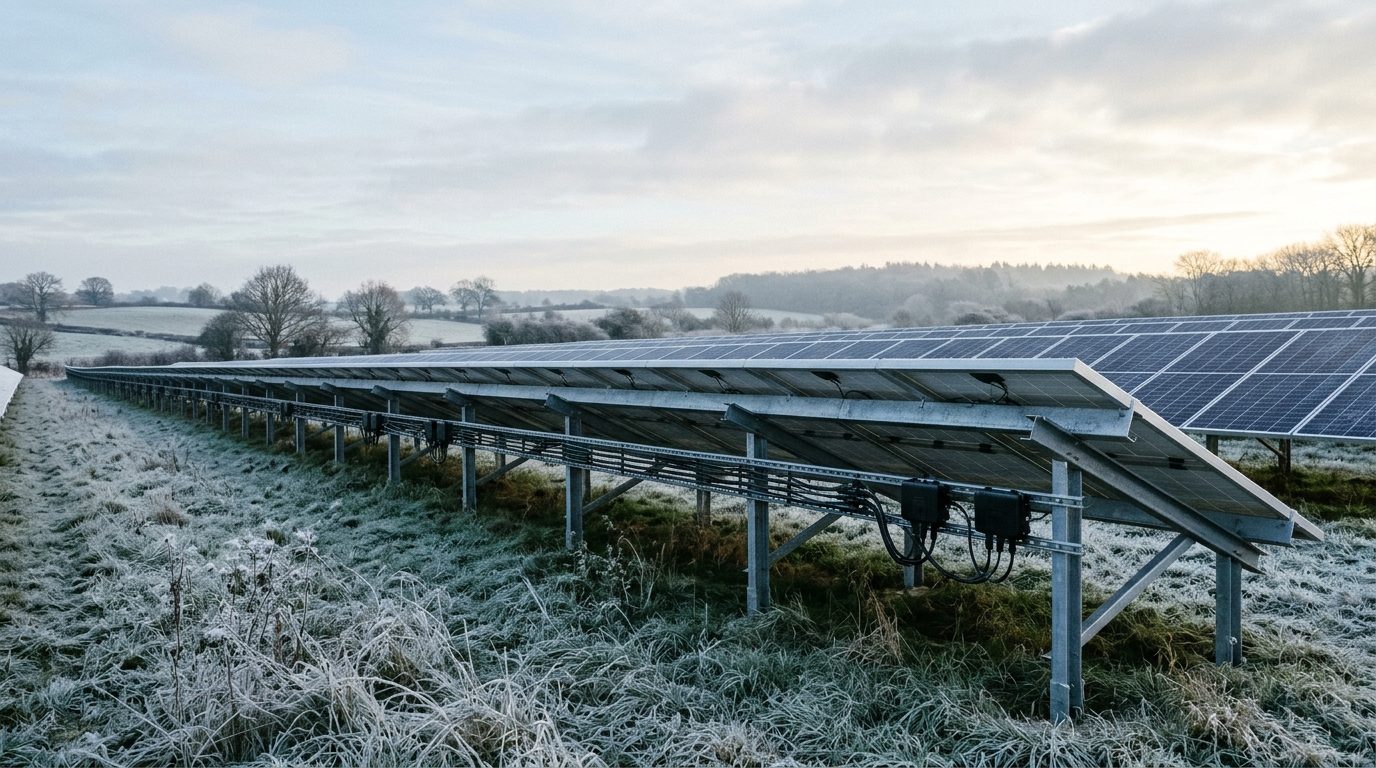
This example uses −10 °C, which is 35 °C below the 25 °C STC point. Both BDV sheets list a Voc temperature coefficient of −0.25%/°C. The rise is 0.25 × 35 = 8.75%, so the multiplier is 1.0875. NEC 690.7, as Mike Holt summarizes it for EC&M, requires that correction and states a 600 V DC cap for one- and two-family dwellings and a 1,000 V DC cap for multifamily, commercial, and industrial buildings.
Global F6 Voc is 51.47 V. Cold Voc is 51.47 × 1.0875 = 55.97 V.
- 10 modules × 55.97 V = 559.7 V, under 600 V
- 17 modules × 55.97 V = 951.5 V, under 1,000 V
- 26 modules × 55.97 V = 1,455 V, under the F6 module rating of 1,500 V
An 11th F6 module reaches 615.7 V and misses a 600 V dwelling cap. On the US G6B sheet, cold Voc is 52.50 × 1.0875 = 57.09 V: 10 modules reach 570.9 V, 17 modules reach 970.5 V, and 26 modules reach 1,484 V. The 1,500 V line is the module rating on the F6 sheet, not the dwelling cap in that EC&M article.
A site colder than −10 °C fits fewer modules. A site that never reaches −10 °C fits more. The monofacial STC Voc is 51.02 V, and the Tiger Pro family spans 52.97–53.42 V. Those counts need the temperature coefficient printed on their own sheets.
Does a Jinko 580W panel fit a house roof?
A Jinko 580W panel can go on a house roof when the structure can carry the weight and every string stays inside 600 V. The residential module to price first is the 440 W Tiger Neo, 1.998 m², on the 440 W residential Tiger Neo page. The 580 W module covers 2.583 m² (2278×1134 mm).
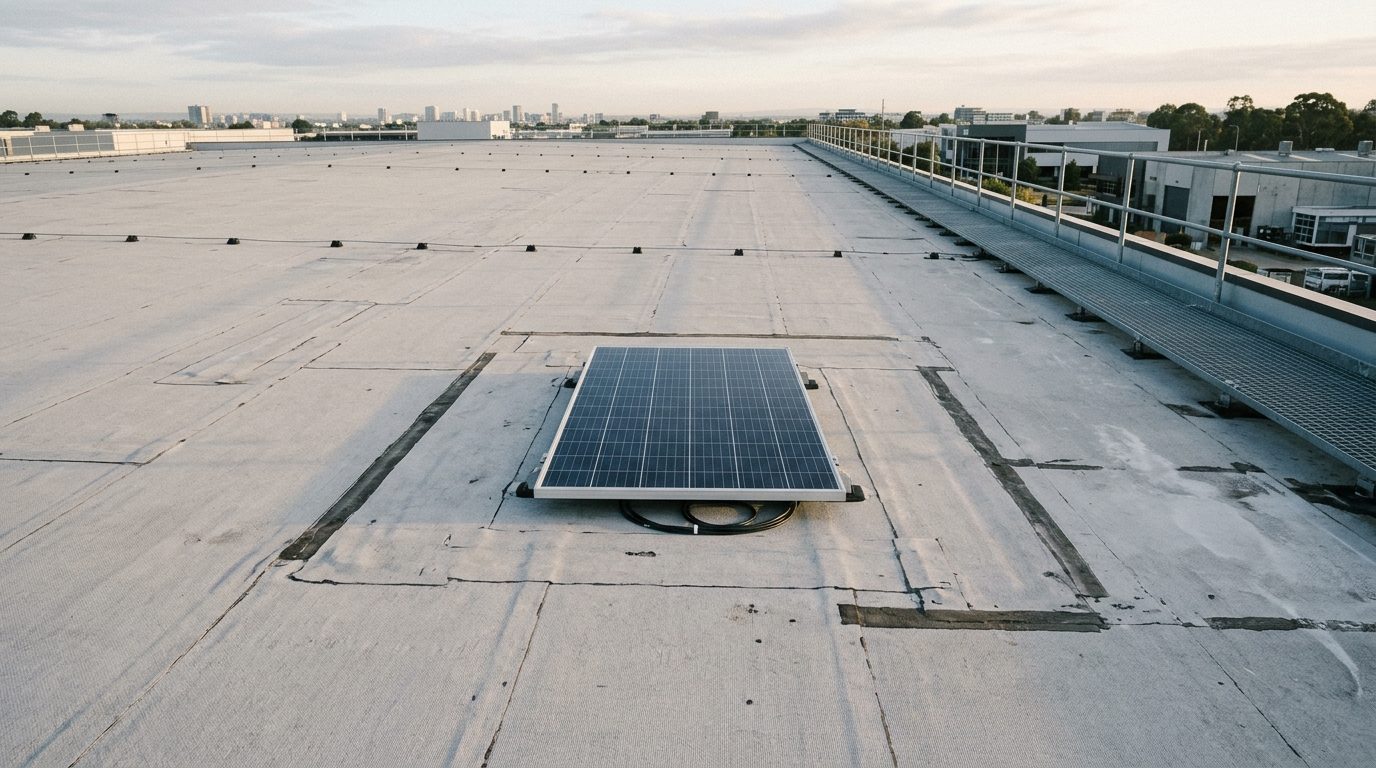
The dual-glass module weighs 32 kg (70.55 lb) on the F6 sheet and 31 kg (68.34 lb) on the US sheet. That is about 12.4 kg per square meter at 32 kg, and about 12.0 kg per square meter at 31 kg. On a one- or two-family house the 600 V limit holds a string to 10 modules, 5,800 W. A 10 kW nameplate needs 18 modules: 17 × 580 W = 9,860 W, short of 10,000 W, and 18 × 580 W = 10,440 W. Eighteen modules cover about 46.5 m², about 500 sq ft of module area, before setbacks and walkways. Plan on two strings. One string stops at 10.
Use the 580 W on a house when the roof is a large, simple plane and the kilograms are acceptable. A cut-up roof, or a layout drawn for smaller modules, points back to the 440 W.
What warranty does the Jinko 580W have?
The n-type 72HL4-BDV carries a 12-year product warranty and a 30-year linear power warranty. Jinko’s F6 graph shows 99% after year 1 and 87.4% at year 30: a 1% first-year loss, then 0.40% a year. From the end of year 1 to year 30 is 29 steps, and 29 × 0.40 = 11.6 points off 99%. The US G6B sheet states the same finish: at most 1% in year 1, 0.4% a year after that, at least 87.4% at year 30.
Warranted power at year 30 is 580 × 0.874 = 506.9 W.
The p-type 565–585 W Tiger Pro family, which includes the JKM580M-7RL4-V, carries a 12-year product warranty and a 25-year power warranty. pv magazine Australia in July 2020 reported first-year degradation capped at 2% and 0.55% a year after that. End of year 1 is 98%. The next 24 years × 0.55% = 13.2 points, leaving 84.8%. On a 580 W nameplate that is 580 × 0.848 = 491.8 W at year 25, five years before the n-type warranty ends. The 84.8% is this arithmetic. The July article states the rates and does not print 84.8%. Jinko’s May 2020 launch notice used 0.45% a year after year one. Use the warranty packed with the modules.
Warranty backing, test results, and company financials are on the brand review.
What is the JKM580M-7RL4-V?
The JKM580M-7RL4-V is the Tiger Pro 580 W, a p-type module launched in 2020. Jinko launched Tiger Pro on 15 May 2020. The 580 W module in that launch, called 78TW, used monocrystalline PERC cells and tiling ribbon, in monofacial and bifacial versions. Jinko said production would start in the fourth quarter of 2020 and quoted 21.4% efficiency for that module. PV Tech, later in May 2020, credited tiling ribbon and multi-busbar with a 10–15 W gain at the same panel size.
The 565–585 W monofacial panel that includes this part number has 156 p-type mono cells, measures 2411×1134×35 mm (2.734 m²), and weighs 31.1 kg. Efficiency across that range is 20.67% to 21.40%. Voc is 52.97 V to 53.42 V. Vmp is 43.77 V at 565 W and 44.22 V at 585 W. Maximum system voltage is 1,500 V, the operating range is −40 °C to 85 °C, the front glass is 3.2 mm AR-coated tempered glass, and the junction box is IP68. Those figures are from pv magazine Australia’s July 2020 look at the panel. A single Vmp and Imp for the 580 W bin stay out of this comparison: the two 7RL4-V datasheet versions conflict.
The Tiger Pro is 133 mm longer than the Tiger Neo 580 W, and the frame is 35 mm. The F6 sheet lists a Pmax temperature coefficient of −0.29%/°C. At the November 2021 launch Jinko quoted −0.30%/°C for Tiger Neo and −0.35%/°C for p-type. To extend or repair a 7RL4 array, match voltage and current on the discontinued models page.
How does the 580W differ from neighboring Jinko models?
The 580 W that fits is the one whose back face, roof, and remaining warranty match the array you are building.
| Module | Power (W) | Efficiency (%) | Area (m²) | Weight (kg) | Faces | Cell type | Best use |
|---|---|---|---|---|---|---|---|
| 440 W 54HL4R | 440 | — | 1.998 | — | — | n-type | House roof |
| JKM580N-72HL4-(V) | 580 | 22.45 | 2.583 | 27–28 | monofacial | n-type | Roof with no rear light |
| JKM580N-72HL4-BDV | 580 | 22.45 | 2.583 | 31–32 | bifacial | n-type | Ground mount or tracker |
| JKM580M-7RL4-V | 580 | 20.67–21.40 | 2.734 | 31.1 | monofacial | p-type | An existing Tiger Pro string |
Efficiency, weight, and glass for the 440 W 54HL4R are on the Tiger Neo page. The dashes are those blanks, not zero.
A ground mount, a tracker, or a pale flat roof with air under the module calls for the JKM580N-72HL4-BDV. Freeze the string math only after you know the pallet is global F6 or US F30R.
A commercial roof that leaves the back face dark calls for the JKM580N-72HL4-(V).
A house roof calls for the 440 W 54HL4R, unless the plane really is large enough for 2.583 m² modules and a 10-module string still delivers the kilowatts.
More modules on an existing JKM580M-7RL4-V string follow the discontinued-page match. Any 72HL4 replacement goes on its own MPPT.
Is the Jinko 580W n-type?
The 72HL4 modules are n-type. JKM580N-72HL4-BDV and JKM580N-72HL4-(V) carry the N marker and use n-type mono half cells. The JKM580M-7RL4-V is p-type. The M marker, and the PERC cells from the 2020 launch, are the tell.
Can a 7RL4-V and a 72HL4-BDV share one string?
Put a JKM580M-7RL4-V and a JKM580N-72HL4-BDV on separate MPPT inputs. F6 Imp is 13.62 A and Voc is 51.47 V. US G6B Imp is 13.22 A and Voc is 52.50 V. Tiger Pro Voc spans 52.97–53.42 V, and the 7RL4-V sheets do not agree on one Imp, so a mixed string has no single design current. A series string runs at the lowest module current. The frames differ as well: 2411×1134×35 mm against 2278×1134×30 mm. Keep a global F6 pallet and a US F30R pallet apart for the same reason.
What is the Voc of the Jinko 580W?
Voc of the Jinko 580W is 51.47 V on the global F6 sheet and 52.50 V on the US G6B sheet. The monofacial 565–585 W sheet lists 51.02 V. The Tiger Pro 565–585 W family lists 52.97–53.42 V.
How much does a Jinko 580W panel weigh?
A global F6 JKM580N-72HL4-BDV weighs 32 kg (70.55 lb). The US G6B weighs 31 kg (68.34 lb). The monofacial (V) weighs 28 kg on the 35 mm sheet and 27.0 kg on the later 30 mm sheet. The Tiger Pro 7RL4 weighs 31.1 kg.
Check on your quote
- Full code on the quote and on the pallet label: BDV, BDV-F30R, (V), BDX, or 7RL4-V.
- Datasheet revision. F6 and US F3-US list different Vmp, Imp, Voc, and Isc.
- Series fuse and maximum system voltage on that revision: 30 A on these BDV sheets, 25 A and a 1000/1500 V option on the monofacial F4 sheet.
- Warranty paper in the box: 30 years and about 1% in year one on the n-type BDV, 25 years and 2% in year one on the Tiger Pro, and whether the annual rate printed is 0.40%, 0.55%, or 0.45%.
- Design low temperature and the inverter maximum input voltage behind the string count. The counts above use −10 °C.