Short answer: In a US home quote, Jinko vs LONGi solar panels means the EAGLE G6R (n-type TOPCon, 420–440 W, 30-year power warranty) against the Hi-MO 5 monofacial (PERC, 420 W, 21.5%, 25-year product warranty on LONGi’s current US page). Choose the G6R when heat, module count, or the longer power warranty decides the job; choose the Hi-MO 5 when your price per watt is lower and the warranty PDF confirms that 25-year product term, or when a confirmed US-assembled SKU is required for the incentive.
Updated: November 2026
How do the US modules compare side by side?
The pair below is what a residential quote actually lines up: Jinko’s EAGLE G6R, using the 440 W point on datasheet JKM420-440N-54HL4-B-F4-US, and LONGi’s Hi-MO 5 monofacial at 420 W. Where the cited page is silent, the cell says “not published”.
| Criterion | Jinko EAGLE G6R | LONGi Hi-MO 5 monofacial |
|---|---|---|
| Cell type | n-type TOPCon; cell efficiency over 26% | PERC, gallium-doped |
| Power (W) | 420–440; 440 on JKM440N-54HL4R-B | 420 |
| Module efficiency (%) | 22.02 at 440 W | 21.50 |
| Pmax temperature coefficient (%/°C) | -0.29 | -0.340 |
| Dimensions (mm) | 1762×1134; thickness not published | 1722×1134×30 |
| Weight (kg) | not published | 20.8 |
| Product warranty (yr) | 12 | 25 on the current US page |
| Power warranty (yr) | 30, linear | 25 |
| First-year and annual degradation | 1% in year 1, then 0.40%/yr; about 87.4% at year 30 | not published |
| Kiwa PVEL 2025 Top Performer | All 7 categories, 11th straight year; models not named | 8th time (TC, MSS, PID, LID+LETID, PAN); models not named |
| US factory status | 2 GW Florida plant; 75.1% sale to FH Capital agreed May 2026 | Illuminate USA, Ohio; LONGi stake below 25% |
Cell type, the 420–440 W range, and the 12-year / 30-year warranty come from Jinko’s US EAGLE G6R page, seen November 2026. The 440 W point values — 22.02%, 1762×1134 mm, 108 cells, -0.29%/°C, and the degradation steps — come from the Tiger Neo guide for JKM440N-54HL4R-B. Every Hi-MO 5 monofacial figure comes from LONGi’s US product page, seen November 2026. Scorecard and factory cells are brand-level; the pages behind them do not name these SKUs.
Which Jinko and LONGi panels are sold in the US?
LONGi’s US module menu lists Hi-MO 5 only: monofacial, bifacial, and Ice-Shield. At RE+ in September 2025, LONGi showed PERC Hi-MO 5 for the US, TaiyangNews reported. The distributed-generation module on that booth list was the LR5-54HPB (108 M10 half-cells, 1722×1134×30 mm): 21.5% with imported cells, and 21% on the version labeled Domestic Content Cell. The same report described the (v4) LR5-72HBD, up to 560 W and 21.7%, as assembled in the US.
The monofacial page is the 54-cell module, 108 half-cells in a 6×18 layout on an M10 wafer, rated 420 W. It lists gallium-doped technology against LID (light-induced degradation). Ice-Shield is a different module: 555 W, 21.5%, 144 cells, 2278×1134×30 mm, 39.5 kg, hail certified to 65 mm, the same -0.340%/°C, and a 12-year product / 30-year power warranty. A quote that says Ice-Shield does not inherit the monofacial warranty row. The bifacial Hi-MO 5 is on the same menu; the residential spec with a published 420 W rating is the monofacial.
Jinko’s US site lists EAGLE G6 and EAGLE G7, all TOPCon, with cell efficiency stated as over 26%. G6 suffixes on that page are G6X, G6B, and G6R. G7 includes a G7B. The residential black module in this comparison is the G6R. Jinko’s page describes a black backsheet and frame, 3.2 mm front glass, a Fire Type 1 rating, and a twin-array layout for shade. It does not publish a shade-loss percentage. A quote stamped G7 or G6X is still outside the table. Read the code.
On JKM420-440N-54HL4-B-F4-US, 420–440 is the watt class, N marks n-type, and 54 is the cell format. The Tiger Neo guide lists JKM440N-54HL4R-B — the US G6R at 440 W — as 108 cells. B lines up with the black backsheet and frame. The G6R page does not define HL4 or F4. A different suffix belongs on the model-code guide before you compare it with a Hi-MO 5.
Tiger Neo 3.0 is not the module in that code. Jinko’s delivery note for the 3.0 series runs to the end of 2026 for the global market and excludes the US.
How much power does each panel lose on a hot roof?
A hot roof only changes this ranking if you run the coefficient. Set the cell at 65 °C. STC is 25 °C, so the rise is 40 °C, and irradiance stays at the nameplate test condition. Soiling, wind, and the inverter are outside the arithmetic. It is not a field test.
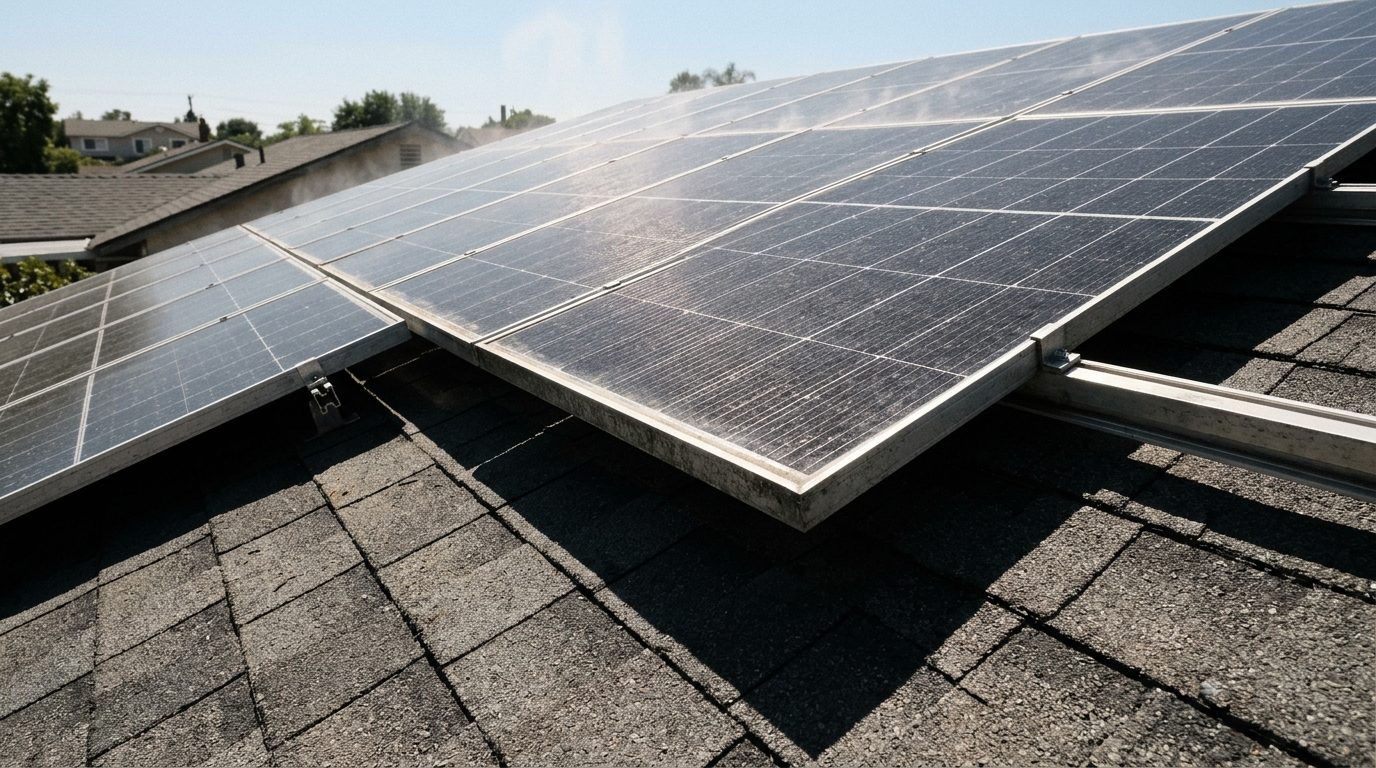
The Hi-MO 5 monofacial coefficient is -0.340%/°C. Forty degrees costs 13.6% of rated power, and a 420 W module delivers about 362.9 W.
JKM440N-54HL4R-B is listed at -0.29%/°C. Forty degrees costs 11.6%, and a 440 W module delivers about 389.0 W. The coefficient gap is 2.0 points of nameplate. The 26 W gap between those two results is wider than 2 points, because the Jinko example starts at 440 W. A 420 W G6R at the same -0.29%/°C lands at about 371.3 W, which is 8.4 W more than the Hi-MO 5.
Check the coefficient on your sheet before you keep that gap. Jinko’s global Tiger Neo page prints -0.26%/°C in the header and -0.29%/°C in the technology section. The figures above follow -0.29%/°C, the value given for the US 440 W model. A datasheet that prints -0.26%/°C loses 10.4% over the same 40 °C, and a 440 W module delivers about 394.2 W.
Which warranty covers more, Jinko or LONGi?
Product cover and power cover point opposite ways, and LONGi’s product years conflict with its own 2022 launch release.
Jinko’s EAGLE G6R page lists a 12-year product warranty and a 30-year linear power warranty. LONGi’s Hi-MO 5 monofacial page lists 25 years of product warranty and 25 years of power warranty. LONGi’s September 2022 US launch release for this 54-cell module said 12-year materials and processing on the monofacial all-black module, plus a 25-year linear power warranty. The bifacial dual-glass module in that release was 12-year product and 30-year linear power. The current monofacial page and the launch release disagree on product years. Power years for the monofacial agree, at 25.
Ask the installer for the warranty PDF that matches the serial numbers. Treat 25 years of product cover as real only when that PDF says so.
On power, the G6R schedule is the one with a published end point. Year 1 takes 1%, then 0.40% per year. After 30 years that is about 87.4% of nameplate, or about 384.6 W from a 440 W module. The Hi-MO 5 monofacial page lists 25 years of power warranty and does not state the degradation schedule, so remaining power at year 25 cannot be calculated from that page. An Ice-Shield quote follows that module’s own listing: 12-year product and 30-year power.
Longer product cover belongs to the Hi-MO 5 monofacial, and only after the PDF matches the current page. Longer power cover belongs to the G6R.
How many panels does an 8 kW system need?
To clear 8 kW of nameplate, you need 19 of the 440 W G6R modules, or 20 of the 420 W Hi-MO 5 modules.
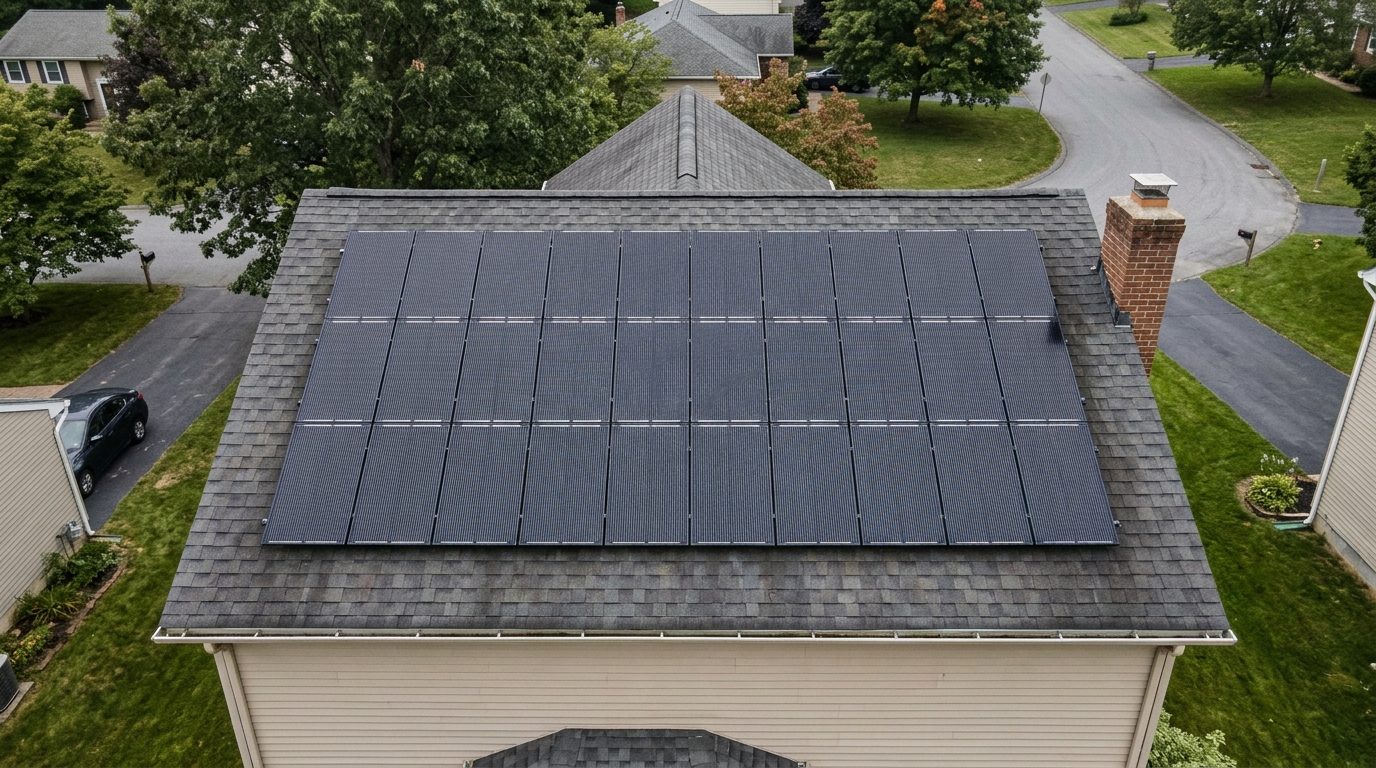
Eighteen G6R modules are 7.92 kW (18 × 440 W = 7,920 W), short of 8 kW. Nineteen are 8.36 kW (8,360 W). Nineteen Hi-MO 5 modules are 7.98 kW (19 × 420 W = 7,980 W), also short. Twenty are 8.40 kW (8,400 W). The two arrays that clear the target sit 40 W apart. The Jinko array uses one fewer module.
Face area is close, and it is not identical. A G6R face of 1762×1134 mm is about 2.00 m², so 19 modules cover about 38.0 m². A Hi-MO 5 face of 1722×1134 mm is about 1.95 m², so 20 modules cover about 39.1 m². That is about 220 W per square meter on the 440 W G6R and about 215 W per square meter on the 420 W Hi-MO 5. Those figures are glass area only. Racking gaps and fire setbacks sit on top.
One fewer module is one fewer clamp set. On a module-level design it is also one fewer microinverter or optimizer. LONGi’s 2022 launch release said the 54-cell Hi-MO 5 works with Enphase microinverters, SolarEdge optimizers, and string inverters. The G6R page does not list inverter brands, Voc, or operating current. That match happens on the datasheet in the quote.
How do Tiger Neo 3.0 and Hi-MO X10 compare?
Readers search for the flagship pair. Neither module is what a typical US home quote carried in 2026. Jinko’s Tiger Neo 3.0 page sets delivery at the end of 2025 for what it calls important markets, and at the end of 2026 for the global market, excluding the US. LONGi launched Hi-MO X10 in Spain and Portugal in February 2025, in 54-, 60-, and 72-cell versions from the second quarter of 2025. It is not on LONGi’s US module menu.
| Criterion | Jinko Tiger Neo 3.0 | LONGi Hi-MO X10 |
|---|---|---|
| Power (W) | 670 (range 650–670) | 670 |
| Module efficiency (%) | 24.8 (24.06–24.80 across the range) | 24.8 |
| Cell | TOPCon, 27% | HPBC 2.0 back contact, 26.6%; zero-busbar; n-type wafer |
| Pmax temperature coefficient (%/°C) | -0.26 | -0.26 |
| Degradation | 1% in year 1, then 0.35%/yr; at least 88.85% after 30 years | 1% in year 1, then 0.35%/yr; year-30 floor not published |
| Product warranty (yr) | 12 | not published |
| Power warranty (yr) | 30 | 30 |
| Extra | Bifaciality 85±5%; 2382×1134×30 mm; 32.5 kg | Shading optimizer claimed to cut partial-shade power loss by over 70% |
The 670 W, 24.8%, 27% cell, 85±5% bifaciality, -0.26%/°C, and the US exclusion are from Jinko’s Tiger Neo 3.0 page. The wattage range, dimensions, weight, 12-year product term, 0.35%/yr step, and 88.85% floor are from pv magazine’s September 2025 launch report. Hi-MO X10 figures are from LONGi’s February 2025 launch notice. On those numbers the flagships tie at 670 W, 24.8%, and -0.26%/°C, with the same degradation steps. Jinko prints the higher cell efficiency and a bifaciality figure. LONGi’s distinction is the back-contact cell and a shading claim that remains LONGi’s claim. The launch notice does not state an X10 product-warranty length.
Who backs a 25- or 30-year warranty?
FY2025 left both companies in the red. On the published loss alone, Jinko’s is the smaller one, though one year’s results do not settle which company is the firmer backer of a long power warranty. The condition that flips the ranking is a later audited year in which LONGi’s loss keeps shrinking and Jinko’s widens. The warranty PDF still outranks either income statement.
TaiyangNews reported Jinko’s FY2025 module shipments at about 86 GW, down 7.3% from 92.9 GW. Revenue was RMB 65.50 billion, down 29%. Gross margin was 2.2%, from 10.9% the year before. Net loss was RMB 4.45 billion, after net income of RMB 54.5 million in 2024. US shipments were about 5% of the 2025 total. Shipment guidance for 2026 was 75–85 GW.
LONGi’s FY2025, also via TaiyangNews, was revenue of RMB 70.3 billion (down 14.8%) and module shipments of 86.58 GW (up 19%), of which 22.87 GW were back-contact. Net loss was RMB 6.4 billion, narrowed from RMB 8.6 billion, and it was the second straight annual loss. LONGi said it “reduced its ownership stake in the US solar module joint venture (JV) due to complex and evolving US trade policies.” Illuminate USA, that venture, was described as running at full capacity.
Jinko’s loss is the smaller one, by RMB 4.45 billion against RMB 6.4 billion. LONGi shipped slightly more modules, including 22.87 GW of back-contact, on higher revenue. A 2.2% gross margin at Jinko is a thin cushion. More of Jinko’s scorecard history and financial record is on the Jinko panel review.
Factory ownership has been changing. A US-made label is a SKU fact, not a brand fact.
Jinko operates a factory in Florida. In May 2026, pv magazine reported that FH Capital agreed to buy 75.1% of Jinko Solar (U.S.) Industries Inc., with Jinko keeping 24.9%. The stake includes a 2 GW module factory. FH Capital’s stated plan is to double capacity to at least 4 GW and add BESS manufacturing. The report said closing still depended on conditions and regulatory approvals, and that the ownership change may help the plant meet foreign-entity limits and a domestic-content bonus. Reuters reported the same 75.1% sale and placed the plant in Florida.
LONGi’s US factory is Illuminate USA in Ohio, built in 2024 with Invenergy and employing about 1,700 people, according to Reuters. That report said LONGi’s stake was cut below 25% and the IP agreement was renegotiated. Reuters tied both stake sales to a federal cap: Chinese companies limited to 25% ownership of plants seeking federal subsidies, under the law that report calls the One Big Beautiful Bill.
Kiwa PVEL’s 2025 scorecard named both brands. Jinko’s June 2025 release says Top Performer in all seven test categories, an eleventh straight year, and one of two manufacturers with that result in every edition. LONGi’s release says an eighth Top Performer award, in TC, MSS, PID, LID+LETID, and PAN, and one of three module types worldwide with the top rating in PAN file testing. Neither release names the tested model. Read it as a brand record. The pallet on the quote is untested in those pages.
Check which company name signs the warranty PDF. A stake sale does not, by itself, tell you who pays a claim.
Who should pick Jinko, and who should pick LONGi?
Pick the EAGLE G6R when the roof runs hot, when the array is short on space, or when the power warranty is the term you are buying. At a 65 °C cell the G6R loss is about 11.6%, against about 13.6% for the Hi-MO 5 monofacial. Nineteen 440 W modules clear 8 kW at 8.36 kW and about 38.0 m² of module face, one module under the Hi-MO 5 count. The published curve still shows about 87.4% at year 30.
Pick the Hi-MO 5 monofacial when the quote is materially cheaper per watt and the warranty PDF confirms the 25-year product term on the current US page. Also pick it when the installer confirms a US-assembled or domestic-content SKU that the incentive on your job actually requires. The Domestic Content Cell LR5-54HPB shown at RE+ 2025 was listed at 21%, not 21.5%. If that PDF still carries the 2022 monofacial terms — 12-year product and 25-year power — the product-warranty reason to choose LONGi is gone.
The Hi-MO 5 in a US quote is a PERC module with the efficiency and warranty on that page. TOPCon and the 30-year power term are the G6R side of this pair. The 24.8% flagship figures belong to Tiger Neo 3.0 and Hi-MO X10, which were not the modules in a US home quote in 2026. The G6R product warranty is 12 years.
FAQ
Is LONGi better than Jinko?
No, not on the modules a US home quote pairs up. The EAGLE G6R leads on cell type, module efficiency (22.02% at 440 W versus 21.50%), hot-roof loss, watts per module, and power-warranty length. LONGi leads on the product years printed on its current monofacial page, 25 against 12, and that lead disappears if the warranty PDF still says 12.
Is LONGi made in the USA?
Some SKUs are. Reuters describes Illuminate USA, the Ohio plant LONGi shared with Invenergy, as a 2024 factory with about 1,700 employees, and says LONGi’s stake is now below 25%. TaiyangNews reported a Domestic Content Cell version of the LR5-54HPB and a US-assembled LR5-72HBD at RE+ 2025. The 420 W monofacial page does not name a factory.
Does Jinko still make panels in the US?
As of the May 2026 reports, yes. Jinko operated a 2 GW factory in Florida, and FH Capital had agreed to buy 75.1% of Jinko Solar (U.S.) Industries Inc., with Jinko keeping 24.9%. pv magazine said the deal still needed closing conditions and approvals. Those reports do not say the sale had closed. The EAGLE line is still the residential range on Jinko’s US site.
Is Jinko Tiger Neo 3.0 available in the US?
Not according to Jinko’s page. Its delivery targets for Tiger Neo 3.0 (end-2025 for important markets, end-2026 for the global market) exclude the US, and it gives no US date. A US quote that says Tiger Neo is the EAGLE G6 or G7 class, often the G6R at 420–440 W, not the 670 W 3.0 module.
Check on your quote
- Match the model code on the invoice to a datasheet. JKM420-440N-54HL4-B-F4-US and JKM440N-54HL4R-B are the G6R codes used here. LR5-54HPB is the Hi-MO 5 class. Ice-Shield and LR5-72HBD are different modules.
- Read the warranty PDF for those serial numbers. Confirm product years, power years, and the degradation table. LONGi’s current monofacial page and its 2022 launch release do not match on product years.
- Use the Pmax coefficient printed on that datasheet. The hot-roof example uses -0.29%/°C for the 440 W G6R and -0.340%/°C for the Hi-MO 5 monofacial, at a 65 °C cell.
- If an incentive depends on domestic content, get factory and cell origin for that SKU in writing. The domestic-content Hi-MO 5 cell option at RE+ 2025 was listed at 21% efficiency.
- Count racking and power electronics with the module count. Clearing 8 kW takes 19 modules at 440 W or 20 at 420 W, and an MLPE design changes the optimizer or microinverter count by one.