Updated: November 2026
Short answer: On November 24, 2026, new Jinko solar panels at US stores ran about $0.45–$0.55 per watt: roughly $199–$240 for a 440 W panel and $268–$320 for a 580 W bifacial panel. Installed, a complete home system had a 2025 median of $3.00 per watt for cash buyers, per Berkeley Lab data reported by Mercom.
How much do Jinko panels cost by model?
Four live listings for two current codes, checked November 24, 2026, sit in a narrow band once you convert them to dollars per watt. The dollar price on the tag moves with wattage and with whether you buy one panel or a pallet. The per-watt price moves much less.
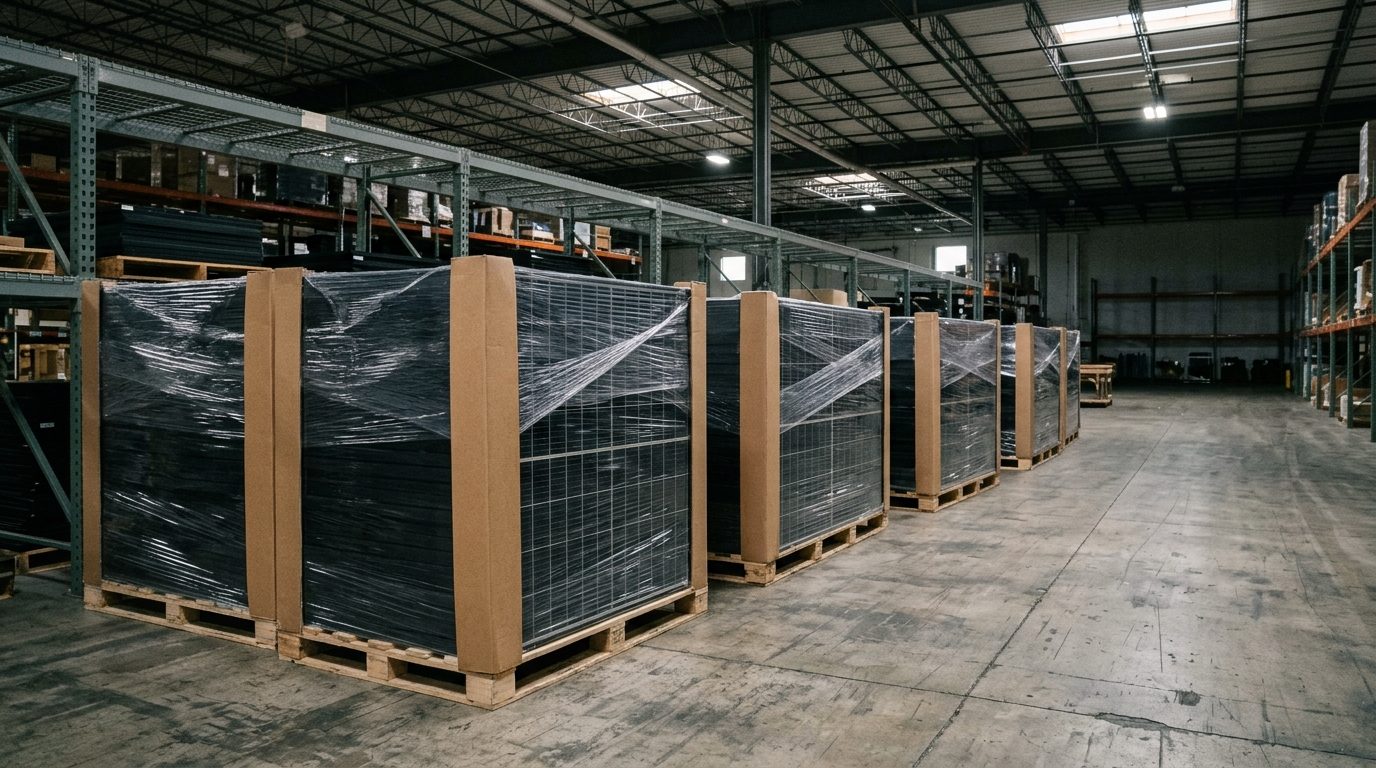
| Model | Wattage (W) | Price per panel ($) | Price per watt ($/W) | Store | Date seen | Notes |
|---|---|---|---|---|---|---|
| JKM440N-54HL4R-B | 440 | 220.00 sale; 240.00 regular | 0.50 sale; 0.545 regular | Dragon Off Grid | Nov 24, 2026 | Single panel. Page said last 4 in stock as of Nov 12, 2026. |
| JKM440N-54HL4R-B | 440 | 199.14 | 0.453 | RC City Home Energy | Nov 24, 2026 | Pallet of 36 at $7,169.00, listed in stock, about 15.84 kW. LTL freight calculated at checkout. |
| JKM580N-72HL4-BDV | 580 | 267.99 sale; 307.02 regular | 0.46 sale | US Solar Supplier | Nov 24, 2026 | Bifacial. Store states $0.46/W on the sale price. Minimum 12 panels for freight. 36 per pallet. Ship window Dec 1–8, 2026. |
| JKM580N-72HL4-BDV | 580 | 320.00 regular | 0.55 | SunWatts | Nov 24, 2026 | Bifacial. A $300 sale on the page was tied to orders placed by June 1, so the regular price is the one to use. |
Divide the panel price by the nameplate watts. A $220 panel at 440 W is $0.50/W. A $320 panel at 580 W is about $0.55/W. Use the wattage on your quote, and write the date next to the figure. A price with no date is not comparable to this table.
Read the code before you compare two tags. JKM440N-54HL4R-B is a 440 W, N-type, 54-cell monofacial module. Jinko’s US datasheet for that residential family is named JKM420-440N-54HL4-B-R (420–440 W), and the US site describes it as a black-backsheet, black-frame module for homes. JKM580N-72HL4-BDV is a 580 W, N-type, bifacial dual-glass module in the 72-cell format, sold as 144 half-cells. The US datasheet name is JKM580-600N-72HL4-BDV, a 580–600 W band. Store pages still title both as Tiger Neo. The US site files them as EAGLE. Specs for the 440 W family are on the Tiger Neo page, and the 580 W variants are on the 580 W bifacial page.
Why is the China price $0.106/W and the US store price about $0.50/W?
A China export print near $0.11 per watt and a US shelf price near $0.50 per watt are different products in different places. The first is a factory-gate module. The second is a single panel a US buyer can pick up or have trucked.
| Step | What you are buying | Price | Source and date |
|---|---|---|---|
| 1 | TOPCon module, FOB China, under 645 W | $0.106/W | OPIS Chinese Module Marker, report released Nov 17, 2026, as reported by pv magazine Nov 20, 2026. Down 0.93% on the week after five weeks at $0.107/W. |
| 2 | Module imported into the US | $0.38/W | Anza, for modules bought since Aug 7, 2026. Was $0.27/W before those Section 232 rules. Median rise of more than 40%. TOPCon averaged $0.38/W; PERC $0.385/W. Reported by PV Tech Sept 23, 2026. |
| 3 | US-assembled module, wholesale median | $0.30/W | Anza, held through May, June, and early July 2026. Interquartile range $0.280–$0.325/W across 55 modules. $0.295/W in April; $0.31/W in Q1 2026. Reported by pv magazine USA July 30, 2026. |
| 4 | New Jinko panel at a US store | $0.45–$0.55/W | Store listings in the table above, seen Nov 24, 2026. |
| 5 | Full residential system, installed | $3.00/W cash; $3.60/W all host-owned | Berkeley Lab 2026 update, 2025 installs, inflation-adjusted and before incentives. Reported by Mercom Oct 6, 2026. |
Per Anza data reported by PV Tech, the average price of modules brought into the US rose from $0.27/W to $0.38/W for purchases since August 7, 2026. That landed import price is already more than triple the $0.106/W FOB China marker. The store price adds another step, from about $0.38/W at the border to about $0.45–$0.55/W on a shelf.
A wholesale page that quotes a China figure is showing something close to step 1. It does not include the US duty, a distributor, a store, or a truck. From December 4, 2026, modules also face a $0.38/W minimum import price, so a $0.106/W factory price cannot clear US customs as a $0.106 panel. Treat any China listing as a benchmark for the export market, not as a quote you can accept for a roof in the US.
How much of your solar quote is the Jinko panels?
On a typical cash quote, the Jinko panels are about 15–17% of the contract. The rest is the installed system around them.
Berkeley Lab’s median host-owned residential system in 2025 was 7.7 kW, and most systems fell between about 5 and 12 kW. Eighteen 440 W panels are a clean count close to that median:
- 18 × 440 W = 7,920 W = 7.92 kW
- Pallet unit price: $7,169 ÷ 36 = $199.14 per panel
- 18 panels, which is half of that pallet invoice: 18 × $7,169 ÷ 36 = $3,584.50
- Same 18 panels at the $220 single-panel sale price: 18 × $220 = $3,960
- A cash install at the 2025 median of $3.00/W: 7.92 kW × $3.00/W = $23,760
$3,584.50 is 15% of $23,760. $3,960 is 17%. At the top of the store range, $0.55/W is about 18% of a $3.00/W cash price. The share is the panel’s price per watt divided by the installed price per watt, so a 6 kW system at the same two rates lands in the same band. A median-size 7.7 kW system at $3.00/W would be $23,100 before you swap in this 7.92 kW count.
A high quote is rarely the panels, as long as the panel line itself is inside about $0.45–$0.55/W. Among the 100 largest US residential installers, median installed prices ranged from about $2.4/W to $6.3/W in 2025. Judge the quote against that span. The cash median was $3.00/W, down from $3.60/W in 2024. Loan-financed systems ran $4.50/W, and solar-plus-storage ran $4.90/W, both before incentives and inflation-adjusted. A contract near $4.50/W can be the loan, or a battery, with ordinary panel pricing underneath. It stops being “rarely the panels” if the module line is far above $0.55/W on a dated listing.
What moves the price of a Jinko panel?
Six things in the current record actually change what you pay. Tariffs and freight move the total more than the name on the frame.
| Cause | Effect |
|---|---|
| Section 201 safeguard | Expired February 7, 2026. It no longer sets the duty on cells and modules. |
| Section 232 proclamation of August 6, 2026 | Takes effect December 4, 2026. Adds 15% on polysilicon and derivatives, including cells (HTSUS 8541.42.00) and modules (HTSUS 8541.43.00). Sets minimum import prices of $0.38/W for modules and $0.22/W for cells. If the entered value is under the minimum, a specific tariff covers the difference. Per Hunton Andrews Kurth’s summary of the proclamation. |
| Delivery after December 4, 2026 | Anza, via PV Tech, sees those quotes up about 15%. The US Solar Supplier ship window of December 1–8 sits on both sides of that date. |
| Where the module was assembled | Imported modules bought since August 7, 2026 averaged $0.38/W. The US-assembled median was $0.30/W in May through early July 2026. Those are category medians, not a Jacksonville price tag. |
| One panel vs a 36-panel pallet | $220 sale, or $240 regular, for one 440 W panel at Dragon Off Grid, versus about $199.14 on the RC City Home Energy pallet. |
| Panel format | 440 W black-frame residential and 580 W bifacial dual-glass modules both landed at about $0.45–$0.55/W. The 580 W unit costs more dollars because it is a larger module. |
The duty’s start date and the price move are not the same day. The proclamation is dated August 6 and takes effect December 4, and Anza already measured $0.38/W on modules bought since August 7. Ask for the delivery date in writing. A quote for arrival after December 4 should be read against a price about 15% higher than a pre-December import quote, which is what Anza was already seeing.
Freight can erase a cheap panel price. Dragon Off Grid offers free in-store pickup in Ukiah, California, and direct delivery in California and adjacent states. Outside California, Oregon, Nevada, and Arizona, freight is $650–$1,000 for up to 10 panels. Ten 440 W panels at the $220 sale price are $2,200 of modules. That freight adds about $0.15–$0.23 per watt (10 × 440 W = 4,400 W; $650 / 4,400 W is $0.15/W and $1,000 / 4,400 W is $0.23/W). The delivered price is then about $0.65–$0.73/W, not $0.50/W. One panel under the same freight schedule carries the whole $650–$1,000. RC City Home Energy calculates LTL freight at checkout and does not publish a dollar amount on the pallet page, so the $199.14 figure is not a delivered price.
Jinko’s US site says it has a manufacturing facility in Jacksonville, Florida, and also lists plants in Malaysia and Vietnam. Jinko sold a 75.1% stake in the Jacksonville plant to FH Capital for $192 million and kept 24.9%, per pv magazine USA. That article describes this kind of sale as a way to keep projects eligible for tax credits by cutting foreign ownership. It is an ownership fact, not a retail price. No Jacksonville-specific shelf price for a Jinko module is in the listings above. Use the label’s country of origin, then the $/W in the store table.
A separate rule hits modules sold in China, not US store tags. From January 1, 2027, a Chinese standard sets a 23.2% minimum efficiency for TOPCon modules sold in China, equal to about 630 W. pv magazine reports that manufacturers are clearing lower-efficiency stock in the fourth quarter of 2026, and that tier-2 producers are discounting hard. OPIS forward prices in that same report are $0.106/W for first-quarter 2027 loading and $0.105/W for the second through fourth quarters of 2027. Those are FOB China prints. They sit under the US $0.38/W module floor.
Is the panel Tiger Neo or EAGLE G6R?
The same wattage is listed under two names, so check the warranty years on a listing against Jinko’s US site. Compare prices only after the code and the warranty sheet match.
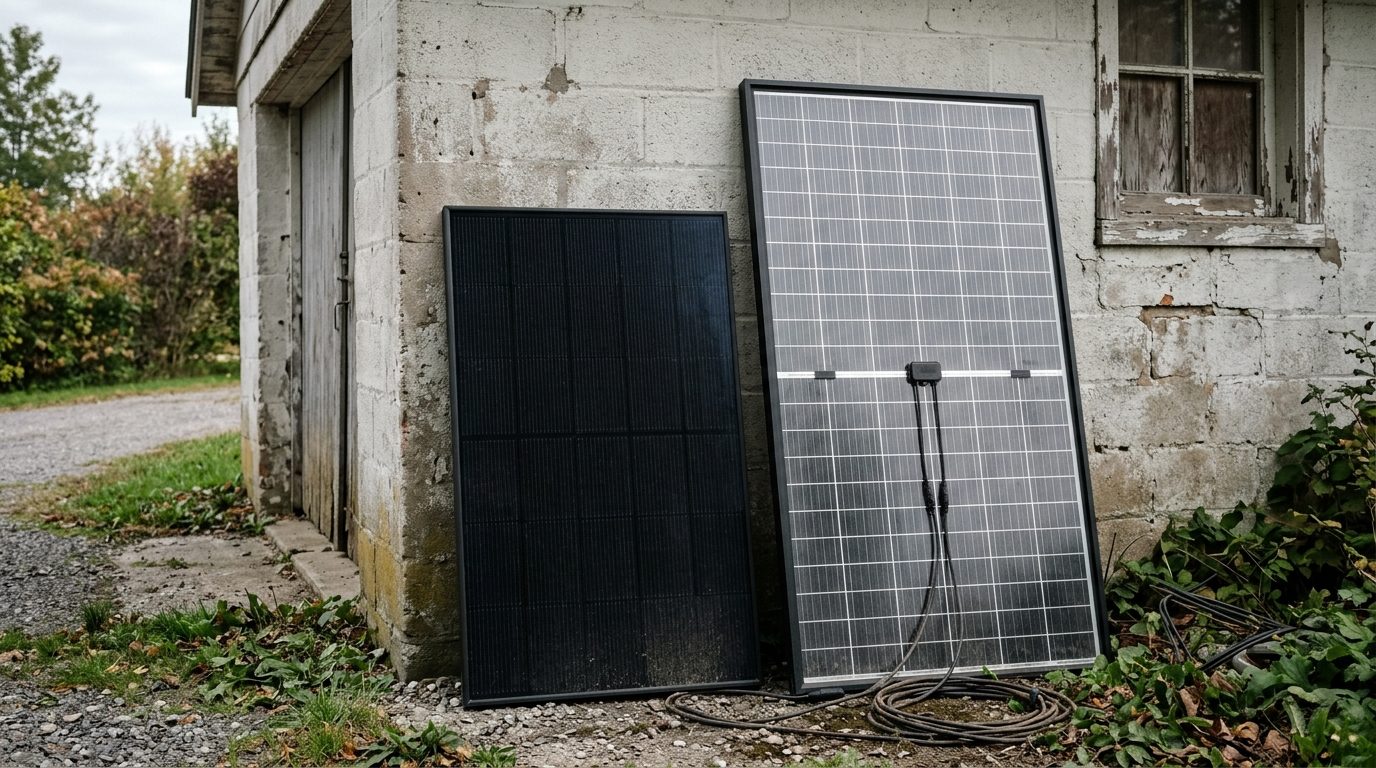
Jinko’s US site sells the residential 420–440 W module as the EAGLE G6R, datasheet file JKM420-440N-54HL4-B-R, with a black backsheet and black frame and N-type TOPCon cells. The EAGLE G6R page lists a 12-year product warranty and a 30-year linear power warranty. The EAGLE G6B (datasheet JKM580-600N-72HL4-BDV, 580–600 W, N-type TOPCon bifacial) carries the same 12-year product and 30-year linear power terms. So does the EAGLE G7B (JKM615-640N-66HL4M-BDV, 615–640 W). Current US lines on that site are EAGLE G7, G7B, G6, G6X, G6B, and G6R.
Many store titles still say Tiger Neo, including the 440 W and 580 W listings in the price table. A Tiger Neo title on a 440 W all-black module is the G6R family if the code is JKM440N-54HL4R-B or JKM420-440N-54HL4-B-R. A Tiger Neo title on a 580 W dual-glass module is the G6B family if the code is JKM580N-72HL4-BDV. A lower price paired with a shorter product warranty is a different offer, not a cheaper copy of the same one. Read the warranty sheet attached to that listing before you rank the prices.
How much is a Jinko 250W, 300W, 330W or 370W panel?
There is no current new-panel price for a 250 W, 300 W, 330 W, or 370 W Jinko module in the sources behind this page. Jinko’s current US lines are the EAGLE series named above.
A listing at 250–370 W does not match the EAGLE datasheets named above, so ask whether it is old stock or a used panel. Compare it on dollars per watt against the $0.45–$0.55/W band for new 440 W and 580 W modules, and check whether any warranty still applies and whether it transfers to you. This page has no used-panel price and no transfer rule to quote. Replacement models and fit notes are on the discontinued Jinko models page.
Does the federal tax credit still lower the price in 2026?
No, not for a homeowner whose installation is completed after December 31, 2025.
The IRS says the Section 25D residential clean energy credit will not be allowed for any expenditures made after December 31, 2025, and that an expenditure for an item is treated as made when the original installation of the item is completed. A contract signed earlier does not keep the credit if the installation is completed in 2026. If a quote still subtracts a 30% federal credit, the number you pay is the price before that line unless the installer can show a completion date in 2025. The Berkeley Lab installed prices above are already before incentives.
Check on your quote
- Match the full JKM code on the quote to the code on the module, suffix included.
- Divide the panel price by the watts and set that $/W next to the November 24, 2026 store band of about $0.45–$0.55/W.
- Mark whether the price is one panel or a pallet, and get freight to your state in writing.
- Get the delivery date, and treat arrival after December 4, 2026 as the higher, post-rule quote.
- Read the product-warranty years on the sheet for that listing before you call two prices the same panel.
Questions buyers also ask
Where can I buy Jinko solar panels near me?
There is no single national shelf price. The November 24, 2026 figures on this page were listed by Dragon Off Grid in Ukiah, California, by RC City Home Energy, by US Solar Supplier, and by SunWatts. On any local quote, check the dealer name and the JKM code. Jinko’s US site lists a factory in Jacksonville, Florida, plus plants in Malaysia and Vietnam. Those are build locations, not a pickup counter in your city.
Are Jinko panels cheaper than other Tier 1 brands?
This page does not have a same-day price for another brand, so it does not answer that. The Jinko vs Canadian Solar comparison is the place for it. Match wattage and date when you do.
Are Jinko panels made in the US?
Some are. Jinko’s US site says it has a plant in Jacksonville, Florida, and also lists plants in Malaysia and Vietnam. Jinko kept a 24.9% stake after selling 75.1% of the Jacksonville plant to FH Capital for $192 million. US-assembled modules as a group had a $0.30/W median in early summer 2026, against $0.38/W for imports bought after August 7. That gap is a category median from Anza, not a guaranteed discount on a Jacksonville Jinko. The quote has to name where that module was made.
Will Jinko panel prices drop in 2027?
Not on the evidence a US buyer can use. OPIS forward prices, reported by pv magazine, are $0.106/W for first-quarter 2027 loading and $0.105/W for the second through fourth quarters. From December 4, 2026 the US minimum import price for a module is $0.38/W. A $0.105/W factory print does not become a $0.105 US panel. No source here gives a 2027 US retail forecast. China’s January 1, 2027 efficiency rule is clearing lower-wattage TOPCon stock at a discount in the export market. Do not time a US purchase off those FOB prints. The finding changes only if you have a dated quote for a US-assembled module delivered under the current $0.45–$0.55/W store band.