Short answer: The Jinko 575W solar panel is a 144-half-cell N-type TOPCon Tiger Neo module, 2278 × 1134 mm, rated 575 W at 22.26% efficiency, for 1500 V commercial and utility arrays. The suffix on JKM575N-72HL4-BDV, -BDX, or -V selects the datasheet, and the four sheets differ in glass and weight, and three different Voc values appear across them.
Updated: November 2026
A listing that prints one Voc for every 575 W code is mixing sheets. Published Voc on these 575 W sheets is 50.88 V, 51.27 V, or 52.30 V, and weight runs from 28 kg to 37.7 kg. The suffix, the frame depth, and the datasheet year separate them.
Which Jinko 575W is in your quote?
The suffix on JKM575N-72HL4 tells you which 575 W build is on the quote. Check the suffix.
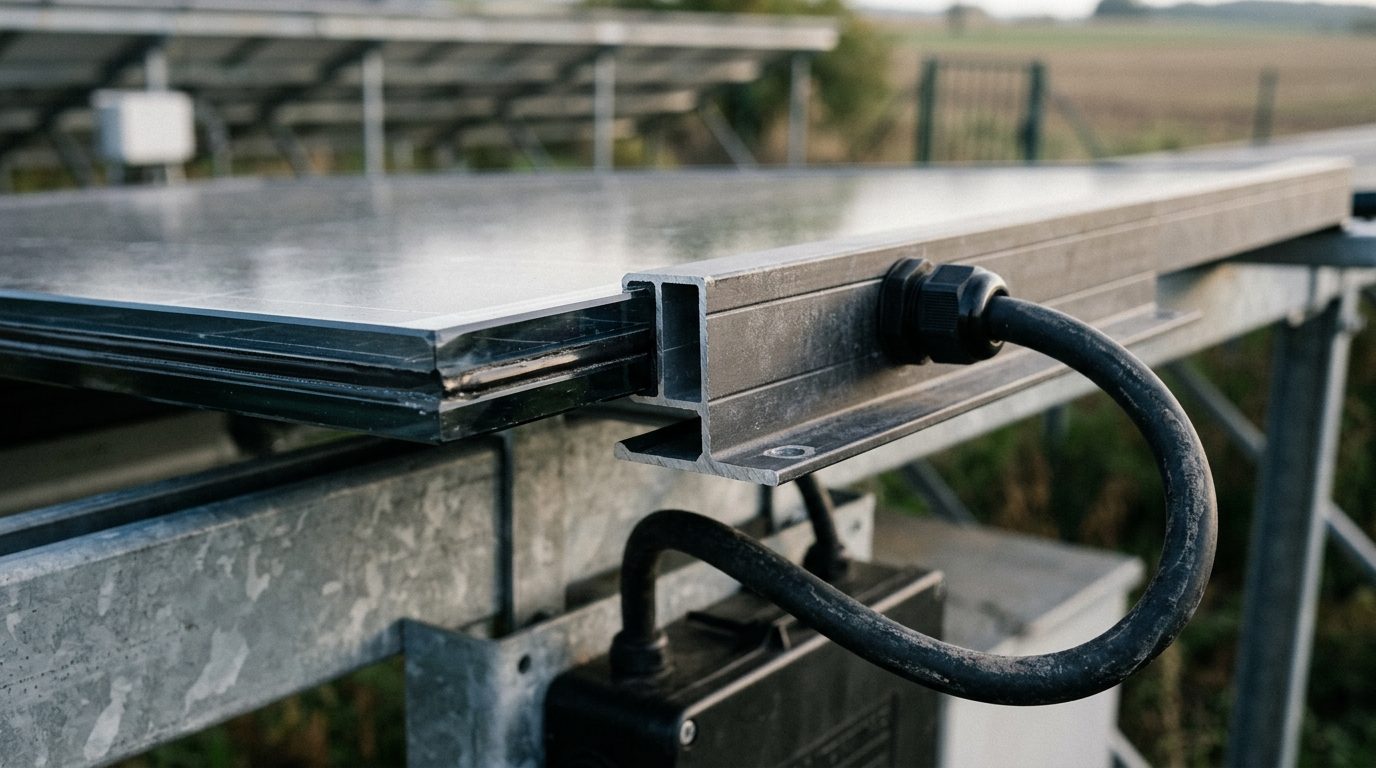
- -V is the monofacial module on the 2021 sheet: 3.2 mm front glass, a 35 mm frame, 28 kg (61.73 lb), Voc 50.88 V.
- -BDV is bifacial dual glass in a 30 mm frame, and two sheets share that suffix. The 2023 F6 sheet lists 32 kg (70.55 lb) and Voc 51.27 V. The 2024 F9 sheet lists 31.0 kg and Voc 52.30 V.
- -BDX is the US EAGLE G6X module: dual glass, a 30 mm frame, 37.7 kg (83.11 lb), Voc 52.30 V, and 12 AWG leads 1400 mm (55.12 in) long.
575 is the nameplate wattage. N marks N-type cells. 72HL4 is the 144 half-cell layout these datasheets print (6 × 24 on the 2021 sheet). The rest of the code is broken out on the model code page.
A 35 mm frame points at the 2021 monofacial sheet. A 30 mm frame still leaves F6, F9, and BDX, so check weight and the cable callout. The 2023 F6 sheet specifies 4.0 mm² cables, +400 mm / −200 mm. The US BDX sheet specifies 12 AWG at 1400 mm, and it names factories in the USA, Vietnam, and Malaysia. If the quote says only “Jinko 575W,” ask for the full JKM string and the datasheet year.
Jinko 575W specs from the datasheets
Jinko 575W specs are 575 W and 22.26% efficiency on every sheet below. Voltage, current, weight, and glass are where the sheets split. Figures are STC except the NOCT power row. The US column is the EAGLE G6X JKM570-590N-72HL4-BDX datasheet (September 2024 upload path). The 2021 column is the JKM555-575N-72HL4-(V) datasheet. F6 is the 2023 JKM560-580N-72HL4-BDV sheet. F9 is the 2024 JKM575-600N-72HL4-BDV sheet.
| Spec | 72HL4-(V) 2021 | BDV F6 2023 | BDV F9 2024 | EAGLE G6X BDX |
|---|---|---|---|---|
| Pmax (W) | 575 | 575 | 575 | 575 |
| Vmp (V) | 42.22 | 42.44 | 43.73 | 43.73 |
| Imp (A) | 13.62 | 13.55 | 13.15 | 13.15 |
| Voc (V) | 50.88 | 51.27 | 52.30 | 52.30 |
| Isc (A) | 14.39 | 14.31 | 13.89 | 13.89 |
| NOCT power (W) | 432 | 432 | — | 433 |
| Efficiency (%) | 22.26 | 22.26 | 22.26 | 22.26 |
| Pmax temp coefficient (%/°C) | −0.30 | −0.29 | −0.29 | −0.29 |
| Voc temp coefficient (%/°C) | −0.25 | −0.25 | −0.25 | −0.25 |
| Isc temp coefficient (%/°C) | +0.046 | +0.045 | +0.045 | +0.045 |
| Size (mm) | 2278 × 1134 × 35 | 2278 × 1134 × 30 | 2278 × 1134 × 30 | 2278 × 1134 × 30 |
| Weight (kg) | 28 | 32 | 31.0 | 37.7 |
| Weight (lb) | 61.73 | 70.55 | — | 83.11 |
| Glass | 3.2 mm tempered, front | 2.0 mm front / 2.0 mm back | 2.0 mm front and back | EAGLE Talon Glass, front and back |
| Fire rating | — | — | Class C | UL Type 30, IEC Class A |
| Front / rear static load (Pa) | — | — | 5400 / 2400 | 6000 / 5400 |
| Max system voltage (VDC) | 1000 or 1500 | 1500 | 1500 | 1500 |
| Series fuse (A) | 25 | 30 | 30 | 30 |
| Bifacial factor | monofacial | — | — | 80±5% |
| Packaging | 31/pallet, 620 per 40′ HQ | 36/pallet, 720 per 40′ HQ | — | 468 per 40′ HQ |
A dash means that line is not in the datasheet figures cited for this page. The 2021 sheet also lists a power tolerance of 0 to +3%.
Plan size on the 2021, F6, and BDX sheets is 89.69 × 44.65 in. Thickness is 1.38 in on the 2021 module and 1.18 in on the F6 and BDX modules. F9 and BDX share one 575 W electrical row: Vmp 43.73 V, Imp 13.15 A, Voc 52.30 V, Isc 13.89 A. They part company on weight (31.0 kg vs 37.7 kg), fire rating, and static load.
Operating range is −40 to +85 °C on the 2021 and F6 sheets, −40 to +70 °C on F9, and −45 to +70 °C on the BDX sheet. NOCT is 45±2 °C on the 2021 and F6 sheets.
Is the Jinko 575W bifacial?
The Jinko 575W is bifacial on the BDV and BDX codes. The -V module is monofacial, with 3.2 mm tempered anti-reflection glass.
The US EAGLE G6X BDX sheet states a bifacial factor of 80±5%. F6 specifies 2.0 mm anti-reflection glass on the front and 2.0 mm heat-strengthened glass on the back. F9 specifies 2.0 mm glass on both faces. A bifacial factor for F6 and F9 is not in the figures cited here.
Rear-side production shows up on a ground mount or over a light surface, where the back glass can see reflected light. On a flush roof the back face sits against the roof, and little light reaches the rear cells. These datasheets do not print a roof-mount rear-gain percentage.
What system does a 575W Jinko panel suit?
A 575W Jinko panel measures 2.278 m by 1.134 m. Multiply those sides and the area is 2.583 m², about 27.8 sq ft, before clamps and gaps. Weight is 28 kg (61.73 lb) on the 2021 monofacial sheet, 32 kg (70.55 lb) on F6, 31.0 kg on F9, and 37.7 kg (83.11 lb) on the US BDX sheet.
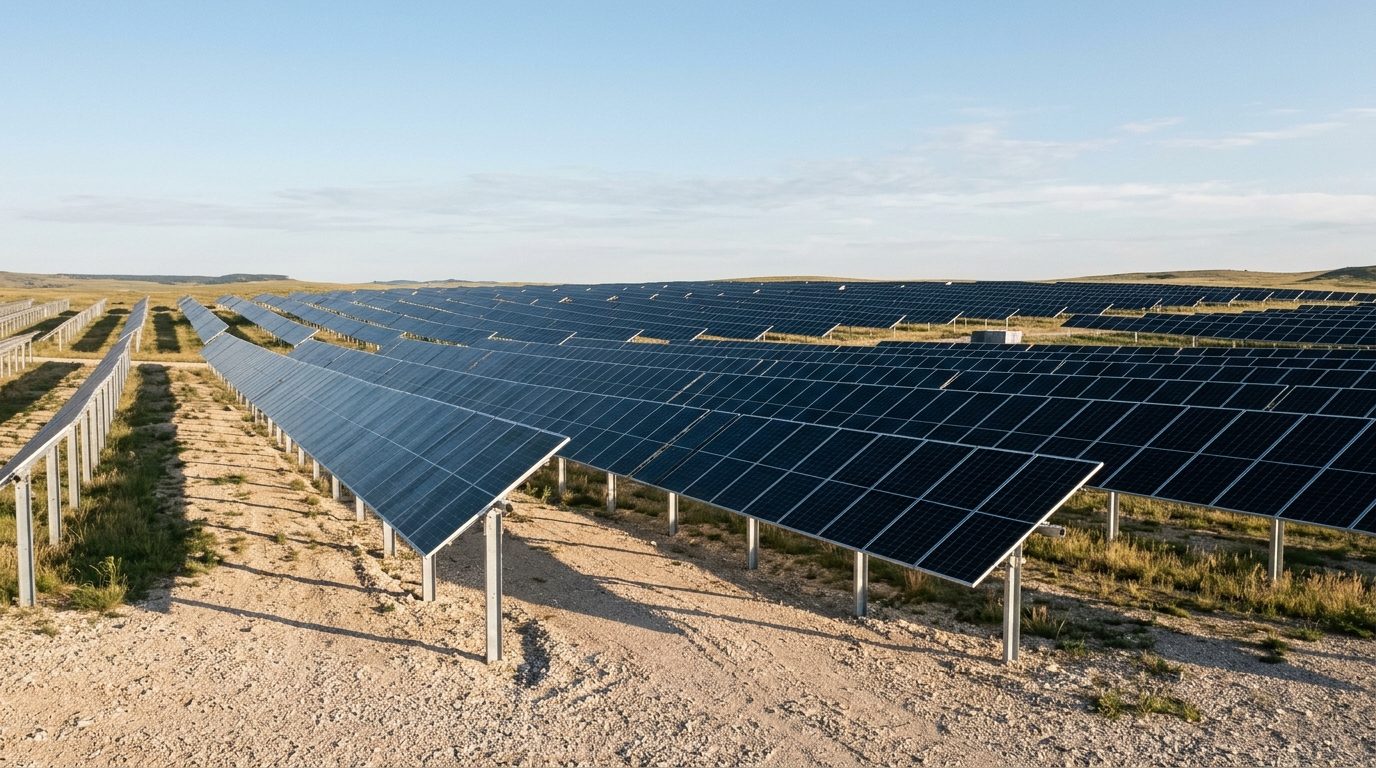
Put this module on ground mounts, carports, and commercial roofs that use a 1500 V inverter. That is the job the later sheets are rated for: 1500 VDC maximum system voltage, a large planform, and a 30-year linear power warranty. The 2021 -V sheet is the voltage-class exception. It lists 1000 or 1500 VDC.
A house roof changes the answer only after two checks. The module is 89.69 × 44.65 in, and twenty US BDX panels weigh 20 × 83.11 lb = 1,662 lb of modules before racking. Twenty monofacial panels weigh 20 × 61.73 lb = 1,235 lb. One- and two-family dwellings also stay at or under 600 V DC, so the string has to be short, or each module needs its own microinverter. Skip the dwelling roof when nobody has checked the structure for that weight.
Twenty panels are a clear size example. 20 × 575 W = 11,500 W, which is 11.5 kW DC. Module area is 20 × 2.583 m² = 51.66 m², about 51.7 m² (556 sq ft). Walkways and setbacks sit outside that rectangle. The datasheets do not give a setback distance.
Where the sheets state a mechanical load, F9 lists 5400 Pa front and 2400 Pa rear. The BDX sheet lists 6000 Pa front, tested as snow, and 5400 Pa rear, tested as wind, plus hail of 55 mm at 33.9 m/s. BDX fire rating on that sheet is UL Type 30 and IEC Class A. F9 lists Class C.
How many 575W panels per string?
Ten Jinko 575W panels is the maximum string on a 600 V residential circuit at a design low of −20 °C (−4 °F). That count holds for every 575 W sheet on this page. Seventeen is the maximum at 1000 V under the same assumption. At 1500 V the count is 25 on the 52.30 V sheets and 26 on the older, lower-Voc sheets.

Every sheet here uses a Voc temperature coefficient of −0.25%/°C. STC is 25 °C, so a −20 °C site is a 45 °C drop. The scale factor is 1 + 0.0025 × 45 = 1.1125. Cold Voc is STC Voc times that factor. NEC 690.7 limits one- and two-family dwellings to 600 volts, and the Voc rise at low ambient temperature has to be included in the calculation (Pete Jackson, IAEI Magazine, September/October 2019).
BDX and F9 start at 52.30 V:
52.30 × 1.1125 = 58.18 V.
600 / 58.18 = 10.3, so you stop at 10 modules. Eleven would be 11 × 58.18 = 640 V. At 1000 V, 17 × 58.18 = 989 V, and 18 modules would be 1,047 V. At 1500 V, 25 × 58.18 = 1,454.5 V, and 26 modules would be 1,513 V.
| Sheet | STC Voc (V) | Voc at −20 °C (V) | Max modules at 600 V | Max at 1000 V | Max at 1500 V |
|---|---|---|---|---|---|
| BDX and BDV F9 | 52.30 | 58.18 | 10 | 17 | 25 |
| BDV F6 2023 | 51.27 | 57.04 | 10 | 17 | 26 |
| 72HL4-(V) 2021 | 50.88 | 56.60 | 10 | 17 | 26 |
F6 is 51.27 × 1.1125 = 57.04 V. Then 26 × 57.04 = 1,483 V, and 27 × 57.04 = 1,540 V. The 2021 module is 50.88 × 1.1125 = 56.60 V. Then 26 × 56.60 = 1,472 V, and 27 × 56.60 = 1,528 V.
The 2021 sheet rates the module for 1000 or 1500 VDC. A 26-module string needs 1500 V equipment. F6, F9, and BDX are rated 1500 VDC on their sheets. The series fuse, 25 A on the 2021 sheet and 30 A on the later sheets, does not set this module count.
Use your site’s design low and the inverter’s own DC limit. Colder than −20 °C raises Voc and shortens the string. A warmer design temperature can add a module. For a different low, with Tmin in °C:
Voc at Tmin = Voc at STC × [1 + 0.0025 × (25 − Tmin)]
Divide the inverter’s maximum DC voltage by that Voc and round down.
Does the Jinko 575W work with Enphase IQ8P microinverters?
A Jinko 575W panel stays under the Enphase IQ8P-72-2-US limits of 65 V maximum input and 20 A maximum module Isc. Cold Voc at the −20 °C assumption is 56.60 V to 58.18 V. Isc on these sheets is 13.89 A to 14.39 A. Both sit inside the IQ8P microinverter data sheet limits (October 2025 revision).
STC Vmp is 42.22 V on the 2021 sheet, 42.44 V on F6, and 43.73 V on F9 and BDX. That range sits inside the IQ8P MPPT window of 36–55 V. NOCT Vmp, on the sheets that print it, is 39.60 V (2021), 39.78 V (F6), and 40.73 V (BDX). Still inside the window.
Enphase’s commonly used module pairing range is 430–670 W, and 575 W falls inside it. Continuous output of the IQ8P is 475 VA, and peak output is 480 VA. The 575 W STC rating is above that continuous output, so some clipping is possible in strong sun. Clipping hours shrink when the module rarely holds STC. Confirm the exact code in Enphase’s compatibility checker. Enphase sets the pass-fail on maximum input DC voltage and maximum module Isc.
Electrical room under 65 V still leaves the roof load. A BDX module at 83.11 lb is a structural question, separate from the voltage check.
What warranty and degradation apply to the Jinko 575W?
The Jinko 575W sheets state a 12-year product warranty and a 30-year linear power warranty, with at least 87.4% of nameplate power at year 30. First-year loss is at most 1%. Each year after that, the loss is at most 0.40%.
Year 30 is 100% minus 1% minus 29 × 0.40%, which equals 87.4%. On a 575 W panel the floor is 575 × 0.874 = 502.55 W, about 502.6 W. That figure is the warranty arithmetic on the EAGLE G6X 72HL4-BDX datasheet, applied to these 72HL4 575 W sheets.
Jinko’s EAGLE G6B and EAGLE G6X product pages, seen November 2026, state the same 12-year product term and 30-year linear power term. Those pages now point at 580–600 W datasheets.
How does the Jinko 575W compare with the 580W and 585W?
The Jinko 575W sits 5 W under the 580 W bin, and 5 / 575 is 0.87% of nameplate. Current US paperwork is the sharper difference. The US EAGLE G6B datasheet covers JKM580-600N-72HL4-BDV at 580, 585, 590, 595, and 600 W, so that file has no 575 W row. The EAGLE G6X product page, seen November 2026, now links a JKM580-600N-72HL4-BDX file in place of the earlier 570–590 W sheet that contained JKM575N-72HL4-BDX.
A US quote still written as 575 W is the earlier G6X BDX sheet, or older global-sheet stock under -V or -BDV. The neighbouring bin is on the Jinko 580W page. EAGLE versus Tiger Neo naming is on the Tiger Neo page.
| Spec | JKM575N-72HL4-BDX | JKM580N-72HL4-BDV (G6B) |
|---|---|---|
| Pmax (W) | 575 | 580 |
| Voc (V) | 52.30 | 52.50 |
| Isc (A) | 13.89 | 13.95 |
| Efficiency (%) | 22.26 | 22.45 |
| Weight (kg) | 37.7 | 31 |
Voc differs by 0.20 V. Weight differs by 6.7 kg: 37.7 kg on the 575 W BDX module, 31 kg (68.34 lb) on the 580 W G6B module. When you compare two quotes, put price per watt next to frame weight and Voc. A 5 W gap is a weak reason to switch bins. A 6.7 kg gap is a different mechanical module. So is a 2021 Voc of 50.88 V set beside a G6B Voc of 52.50 V.
The 585 W bin sits on that same G6B sheet, between 580 and 590. Its electrical row is not tabulated here. The 2023 F6 sheet has its own 580 W bin at Voc 51.47 V, Isc 14.37 A, and 22.45% efficiency. That older 580 W tracks the F6 575 W (Voc 51.27 V), and it does not track the G6B 580 W row above.
Is the Jinko 575W still made?
The Jinko 575W bin is the bottom row of the older sheets. For a new US array, buy from the current 580 W bin. Current US EAGLE files start at 580 W: G6B is JKM580-600N-72HL4-BDV, and the G6X product page now links JKM580-600N-72HL4-BDX (seen November 2026).
Match the old module when you are extending a string that is already 575 W. A 35 mm monofacial module at Voc 50.88 V is the wrong mate for a row of 30 mm BDX modules at Voc 52.30 V. Whether a factory is still laminating 575 W cells, the current US sheets do not say. Replacement pairs are on the discontinued models page.
FAQ
What is the Jinko 575W Voc?
Voc for the Jinko 575W is 50.88 V on the 2021 monofacial sheet, 51.27 V on the 2023 BDV F6 sheet, and 52.30 V on the 2024 BDV F9 sheet and the US EAGLE G6X BDX sheet. At −20 °C with a −0.25%/°C coefficient, those become 56.60 V, 57.04 V, and 58.18 V.
How much does a Jinko 575W panel weigh?
A Jinko 575W panel weighs 28 kg (61.73 lb) as JKM575N-72HL4-V, 32 kg (70.55 lb) on the 2023 BDV F6 sheet, 31.0 kg on the 2024 BDV F9 sheet, and 37.7 kg (83.11 lb) as the US BDX. Plan size is 2278 × 1134 mm on every sheet. Thickness is 35 mm on the 2021 module and 30 mm on the other three.
Is JKM575N-72HL4-V the same panel as -BDV?
JKM575N-72HL4-V is the monofacial module: 3.2 mm front glass, a 35 mm frame, and Voc 50.88 V on the 2021 sheet. JKM575N-72HL4-BDV is dual-glass bifacial in a 30 mm frame, and that suffix covers two sheets, F6 at Voc 51.27 V and F9 at Voc 52.30 V. Keep them apart unless one quote shows one full code and one datasheet.
Is the Jinko 575W on the California CEC list?
The California Energy Commission PV module list includes JKM575N-72HL4-BDV, JKM575N-72HL4-BDX, and JKM575N-72HL4-TV. They are on page 330 of that list, seen November 2026, next to the 570, 580, and 585 W bins of the same series. Check the exact code on your quote against the current CEC file before you use it for a permit.
Can I mix 575W with 580W in one string?
Mix a Jinko 575W BDX module with a G6B 580 W module only after you accept a small current mismatch and a real weight mismatch. Imp is 13.15 A versus 13.22 A, and Voc is 52.30 V versus 52.50 V, while weight is 37.7 kg versus 31 kg. A series string operates at the lower current. The 2021 575 W module, at Voc 50.88 V and Imp 13.62 A, is a different electrical build from the G6B 580 W module at Voc 52.50 V. Match Voc, frame thickness, and datasheet generation. These sheets do not publish a mixed-bin approval.
Check on your quote
- Read the full code. -V, -BDV, and -BDX are different modules, and BDV still splits into the 2023 F6 sheet and the 2024 F9 sheet.
- Match frame thickness. 35 mm is the 2021 monofacial module. 30 mm is F6, F9, or BDX.
- Match sticker Voc to 50.88 V, 51.27 V, or 52.30 V, and weight to 28 kg, 32 kg, 31.0 kg, or 37.7 kg.
- Run cold Voc at your design low. At −20 °C the maximum string is 10 modules on a 600 V one- or two-family dwelling circuit.
- Read the warranty block on the sheet you were handed: 12-year product, 30-year linear power, 87.4% at year 30. For an IQ8P, run that exact code through Enphase’s checker.