Jinko vs Canadian Solar, on the two quotes in front of you, is a choice between a Jinko EAGLE G6R and a Canadian Solar TOPHiKu6.
Short answer: For a typical US rooftop quote the two panels are close. Both are N-type TOPCon, with a 12-year product warranty, a 30-year linear power warranty and a -0.29%/°C temperature coefficient on the sheets cited below.
Canadian Solar’s March 2026 TOPHiKu6 datasheet lists 445–470 W per panel. Jinko’s EAGLE G6R lists 420–440 W. Jinko is the far larger manufacturer and a Kiwa PVEL Top Performer on every scorecard from 2014 through 2026. If both layouts fit, take the lower price per watt. If the roof runs out of room first, take the higher-watt TOPHiKu6, after you confirm the quote is that panel and not HiKu6 PERC.
Updated: November 2026.
Which panels are in a Jinko quote and a Canadian Solar quote?
A Jinko residential quote in the US will often point at the EAGLE G6R. Jinko’s US page lists that module as N-type TOPCon, model JKM420-440N-54HL4-B-R-F2-US, 420–440 W in the datasheet file name, with cell efficiencies of over 26%. Outside the US the same Tiger Neo class is sold as 54HL4R-B. CHOICE’s listing of Jinko’s datasheet for JKM440N-54HL4R-B is the 440 W bin: 22.02% module efficiency, 176.2 × 113.4 cm, ±3% power tolerance.
Read the code as a wattage band (420–440), an N-type cell, and a 54 in the cell-count field. The US catalog number adds -B-R-F2-US. The EAGLE G6R page does not define those letters for glass or frame. The Tiger Neo guide decodes the family, and other codes can be checked against the model list.
EAGLE G6R is the current US badge on the Tiger Neo generation.
The Canadian Solar module in the same size class is TOPHiKu6. Two part numbers show up:
- CS6.1-54TM-H, N-type TOPCon, monofacial. The North America lineup page lists 435–465 W, up to 22.8% efficiency, 1800 × 1134 × 35 mm, on a 182 × 192 mm wafer. The download center’s all-black datasheet v1.4, uploaded March 2026, lists 445–470 W and 108 cells.
- CS6.2-48TM-H, 440–470 W on both the lineup page and that download center, up to 23.5% efficiency, 1762 × 1134 × 35 mm, 96 cells on the datasheet.
The lineup page and the March 2026 PDF disagree by 10 W at the low end and 5 W at the top end of CS6.1-54TM-H. Use the PDF attached to the quote. The TOPHiKu6 family page also advertises up to 620 W and up to 23.0% efficiency, with 16BB cells. Those ceilings cover the whole family, including larger formats. A 54-cell home module is not a 620 W panel.
Check the suffix on the Canadian Solar line. HiKu6 CS6R is dual-cell PERC on 182 mm wafers, 400–420 W in this residential size, 1722 × 1134 × 30 mm, series efficiency up to 21.6%, and the series reaches 555 W in other formats. HiKu6’s warranty is 12 years on materials and workmanship and 25 years linear power. That is an older panel than TOPHiKu6.
How do the two panels compare side by side?
The rows below are the Jinko EAGLE G6R (440 W bin where a single figure exists) against Canadian Solar TOPHiKu6 CS6.1-54TM-H. Company-level rows sit under the panel specs so a shipment figure is not read as a module rating. Sources are named in the cell.
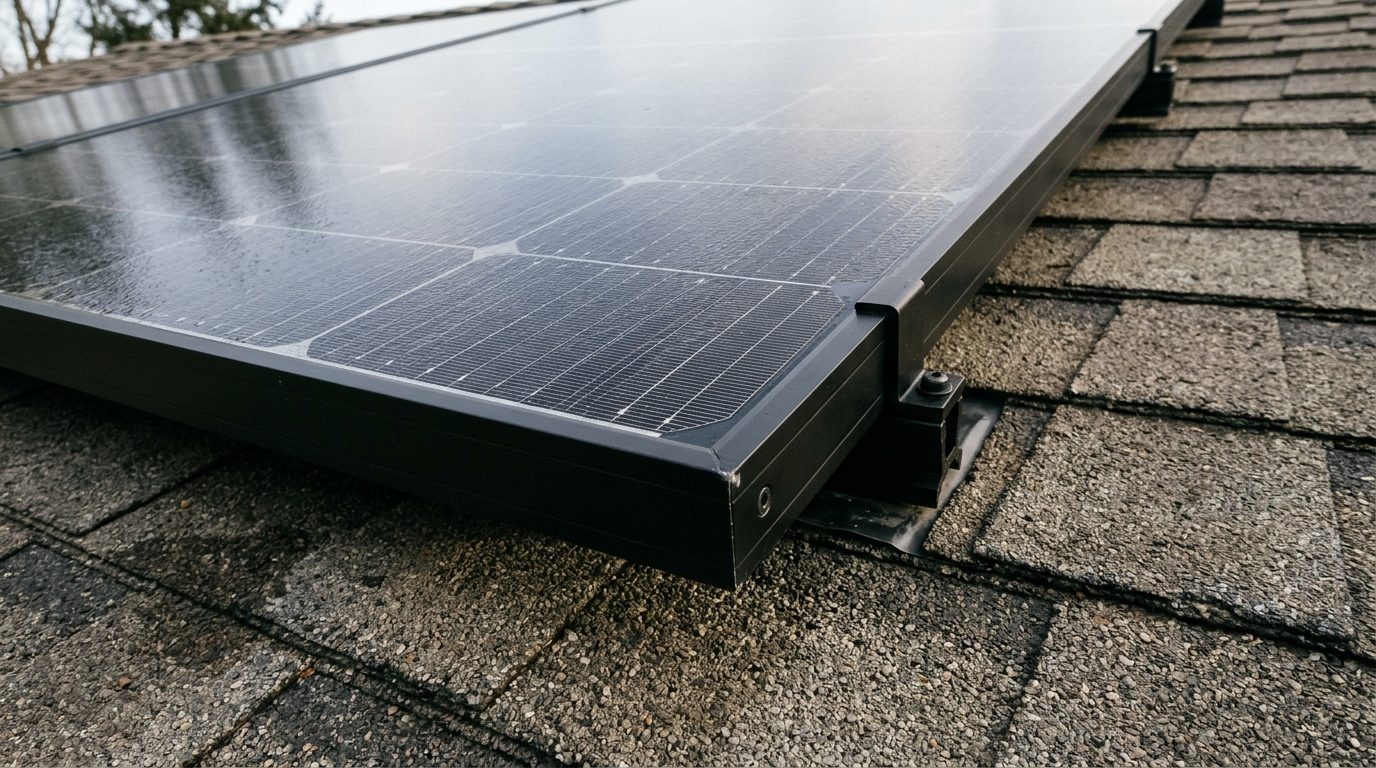
| Criterion | Jinko EAGLE G6R | Canadian Solar TOPHiKu6 CS6.1-54TM-H |
|---|---|---|
| Model on the quote | JKM420-440N-54HL4-B-R-F2-US; Tiger Neo class JKM420-440N-54HL4R-B | CS6.1-54TM-H (also see CS6.2-48TM-H, 440–470 W) |
| Power (W) | 420–440 (Jinko US EAGLE G6R page) | 445–470 (datasheet v1.4, March 2026); lineup page lists 435–465 |
| Module efficiency (%) | 22.02 at 440 W (CHOICE, from Jinko’s datasheet) | Up to 22.8 (lineup page). CS6.2-48TM-H up to 23.5 |
| Dimensions (mm) | 1762 × 1134 at 440 W (CHOICE). Thickness not stated | 1800 × 1134 × 35 (lineup page) |
| Pmax temperature coefficient (%/°C) | -0.29 on the 440 W datasheet (CHOICE) | -0.29 (TOPHiKu6 North America page) |
| Cell type | N-type TOPCon | N-type TOPCon, monofacial; 16BB on the family page; 108 cells on the v1.4 datasheet |
| Product warranty (years) | 12 (EAGLE G6R page) | 12 (TOPHiKu6 page) |
| Power warranty (years) | 30 linear (EAGLE G6R page) | 30 linear (TOPHiKu6 page) |
| Year-30 warranted output (%) | 87.4 on the 440 W datasheet (CHOICE) | Not stated on the TOPHiKu6 page |
| Kiwa PVEL 2026 Top Performer | 7 tests; not listed for UVID | 7 tests; not listed for damp heat |
| PVEL track record | Every scorecard 2014–2026, 12 check marks | 5 years: 2020, 2023, 2024, 2025, 2026 |
| 2026 test BOM factory | Hefei, China | Changshu, China and Sriracha, Thailand |
| US module factory and owner | Jacksonville, Florida, 2 GW. FH Capital 75.1%, JinkoSolar 24.9% (sale announced May 2026) | Mesquite, Texas, 5 GWp. CS PowerTech, Canadian Solar 75.1% |
| 2025 global shipments (GW) | 86,056 MW | 24.3 GW, of which 8.1 GW went to the US |
Jinko’s “over 26%” line is cell efficiency on the EAGLE G6R page. It is not the 22.02% module figure. CS6.2-48TM-H shares the Jinko 440 W footprint, 1762 × 1134 mm, and is 35 mm thick; Jinko’s thickness is not stated in the source.
Which has the better warranty, Jinko or Canadian Solar?
On the current US product pages, the warranties match. Jinko’s EAGLE G6R page states a 12-year product warranty and a 30-year linear power warranty. Canadian Solar’s TOPHiKu6 page states an “Enhanced product warranty on materials and workmanship: 12 years” and a “30 years linear power output warranty,” and tells you to read the Canadian Solar Limited Warranty Statement for the rest (TOPHiKu6, Canadian Solar North America).
The year-30 number is where the sheets split. CHOICE’s listing of the Jinko JKM440N-54HL4R-B datasheet sets degradation at 1% in the first year, then 0.40% per year, and states 87.4% power at the end of year 30. The arithmetic:
- Year 1 leaves 100 − 1 = 99%.
- Years 2 through 30 are 29 steps. 29 × 0.40 = 11.6 percentage points.
- 99 − 11.6 = 87.4%.
On a 440 W bin, 87.4% is 440 × 0.874 = 384.6 W. On the 19-panel layout below (8,360 W), the same ratio is 7,307 W. The TOPHiKu6 page does not publish a first-year drop, an annual rate, or a year-30 percent. The sources here do not say, so 87.4% is applied to the Jinko figure only.
Two public pages still say 25 years, and they are easy to mix up with the lines above. Jinko’s US homeowners page states: “The solar panels come with a standard 25-year power warranty.” That conflicts with the 30-year linear power warranty on the EAGLE G6R page and on the EAGLE G7B page. Separately, CHOICE’s Australian listing of JKM440N-54HL4R-B shows a 25-year product warranty and China as country of origin. A US quote follows the US documents for that SKU. The EAGLE G6R page states 12 years of product cover, so confirm the figure on the datasheet and warranty document attached to the quote. HiKu6, the PERC panel, is a 12-year product warranty and a 25-year linear power warranty.
Same 12/30 wording on both TOPCon pages. The Jinko sheet is the one that prints the slope and the 87.4% end point. The quote’s own datasheet overrides either company’s general page.
How many panels for the same system size?
Panel count below is for an 8 kW array, meaning 8,000 W of STC nameplate. No shading, fire setbacks, inverter limit, or row spacing. Area is the sum of module areas, not the roof rectangle the array occupies.
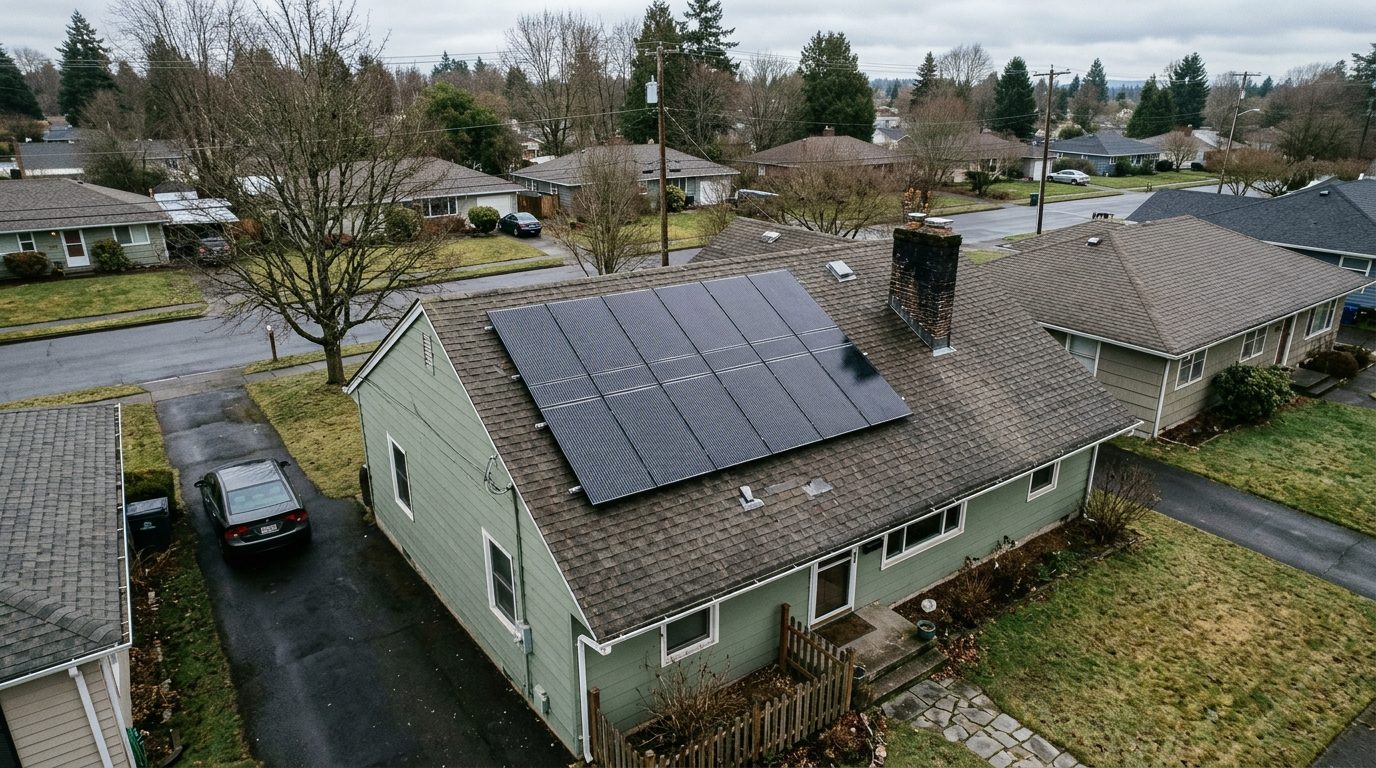
Jinko at the 440 W bin: 8,000 ÷ 440 = 18.2, so 19 panels. 19 × 440 = 8,360 W (8.36 kW). Each module is 1.762 × 1.134 m = 1.998 m². Nineteen modules are 19 × 1.998 = 38.0 m².
Canadian Solar at 455 W, a bin inside both the 435–465 W lineup range and the 445–470 W datasheet range, on the CS6.1 size: 8,000 ÷ 455 = 17.6, so 18 panels. 18 × 455 = 8,190 W (8.19 kW). Each module is 1.800 × 1.134 m = 2.041 m². Eighteen modules are 36.7 m².
Canadian Solar at 470 W, the top of the March 2026 CS6.1 datasheet and of CS6.2-48TM-H: 8,000 ÷ 470 = 17.02. Seventeen panels are 17 × 470 = 7,990 W, 10 W under 8 kW. Eighteen panels are 8,460 W (8.46 kW). Eighteen CS6.1 modules cover about 36.7 m². Eighteen CS6.2 modules, at 1.762 × 1.134 m, cover about 36.0 m².
The wattage gap is one or two modules and roughly 1 to 2 m² of panel area on an 8 kW nameplate. Price per watt moves the quote more than the brand name once you are on these two TOPCon sheets. Divide each quote’s panel price by that panel’s wattage and compare those two numbers.
Which did better in independent testing?
Both brands are Top Performers in seven tests on the 2026 Kiwa PVEL PV Module Reliability Scorecard, the 12th edition (May 2026, updated November 2026). The gaps differ. JinkoSolar is listed for thermal cycling, damp heat, mechanical stress sequence, hail stress sequence, PID, LID+LETID and PAN performance, and is not listed for UVID. Canadian Solar is listed for thermal cycling, mechanical stress sequence, hail stress sequence, PID, UVID, LID+LETID and PAN performance, and is not listed for damp heat (Kiwa PVEL 2026 Top Performers).
The history is not the same length. Jinko is marked Top Performer on every scorecard from 2014 to 2026, 12 check marks. Canadian Solar’s history on that scorecard shows five years: 2020, 2023, 2024, 2025 and 2026.
The 2026 bills of materials were made in Hefei, China for Jinko, and in Changshu, China and Sriracha, Thailand for Canadian Solar. PVEL’s caveat is that the results apply to the tested bill of materials. The scorecard does not say those BOMs were built in Jacksonville or Mesquite. A brand-level Top Performer mark is not a test of the pallet on your quote.
Is Canadian Solar a Chinese company? Are either made in the USA?
Canadian Solar is the parent company. CSI Solar, a related company, keeps a 24.9% stake in the US venture. Since a restructuring announced 1 December 2025, the US factories sit in CS PowerTech. Canadian Solar holds 75.1% of that venture. CSI Solar keeps 24.9%. PV Tech’s coverage ties the move to US foreign-entity-of-concern rules. These sources do not say whether any given module qualifies for a tax credit.
Canadian Solar’s 19 March 2026 SEC filing (Form 6-K) describes the US plants this way. The Mesquite, Texas module factory is 5 GWp, and the filing expected expansion to 10 GWp nameplate by the second half of 2026. Whether that expansion finished is not in these sources. Jeffersonville, Indiana is an HJT cell factory: Phase I at 2.1 GWp, Phase II adding 4.2 GWp by the end of 2026, for 6.3 GWp of US cell capacity. An earlier report said Mesquite, a US$250 million TOPCon assembly plant with 1,500 employees, began module production in the fourth quarter of 2023. On 24 July 2026, PV Tech reported that CS PowerTech had begun n-type HJT cell production at its Jeffersonville facility, which that article calls 6 GW, and said it was unclear whether Mesquite would stay with TOPCon or move to HJT modules. A TOPHiKu6 on a quote is a TOPCon module. The label, not the cell-factory headline, tells you what you are buying.
JinkoSolar’s US site lists facilities in Florida, Malaysia and Vietnam, including a manufacturing plant in Jacksonville, Florida, and notes an NYSE listing since 2010. CHOICE lists China as the country of origin for JKM440N-54HL4R-B. On 11 May 2026 JinkoSolar sold a 75.1% stake in Jinko Solar (US) Industries, the company that runs the 2 GW Jacksonville module plant, to FH Capital, and kept 24.9% (PV Tech, 11 May 2026). Jinko’s 16 April 2026 earnings release still referred to “our 2 GW N-type module facility in the U.S.” That sentence predates the sale announcement.
For your quote, read the factory or country line on the datasheet and on the module label. A Jacksonville module now comes from a plant that is 75.1% FH Capital. A Mesquite module comes from CS PowerTech, 75.1% Canadian Solar. Either brand can also ship an imported module. The pages here do not say which of those your pallet is.
Which company is bigger and more likely to be around for warranty claims?
Jinko shipped more modules in 2025. It also lost more money. Neither result makes one brand a safe warranty counterparty on its own.
JinkoSolar’s full-year 2025 release (16 April 2026): module shipments 86,056 MW, down 7.3% from the year before. Revenue RMB 65.50 billion, reported as US$9.37 billion, down 29.0%. Net loss attributable to ordinary shareholders US$635.6 million. Guidance for 2026 is 75–85 GW of module shipments. The US site says Jinko produces “1 out of 8 modules worldwide.” The test record, the warranty wording and those financials are covered in more detail on the Jinko Solar Panels review.
Canadian Solar’s full-year 2025 filing (19 March 2026): 24.3 GW of modules delivered globally, including 8.1 GW to the US. Net revenue US$5,595.1 million. Net loss attributable to Canadian Solar US$104.1 million, US$2.50 per diluted share. US module guidance for 2026 is 6.5–7.0 GW. The CEO called 2026 “a transition year.” The corporate about page states 180 GW of cumulative module shipments, subsidiaries in over 20 countries, and customers in more than 160 countries.
86,056 MW is more than three times 24.3 GW. Scale favors Jinko if the question is who made more panels last year. Both companies reported a net loss for 2025, so a smaller loss is not a reason to call Canadian Solar the safer balance sheet, and the larger shipment total is not a reason to call Jinko solvent. A claim in year 20 is paid against the written module warranty and the installer’s labor warranty. Company size is background.
The condition that changes the pick: if one quote’s matching datasheet is a 25-year power warranty (HiKu6, or a Jinko page that still says 25) and the other quote’s datasheet is 30-year linear, take the 30-year sheet when the price per watt is close.
Who should pick Jinko, and who should pick Canadian Solar?
Pick Jinko if the longer test record is what you are paying for, and the roof can hold the extra module or two.
- The quote shows EAGLE G6R / JKM420-440N-54HL4R-B (US code JKM420-440N-54HL4-B-R-F2-US), and its price per watt is lower than the Canadian Solar quote.
- You want the manufacturer with a Top Performer mark on every Kiwa PVEL scorecard from 2014 through 2026, and with 86,056 MW shipped in 2025.
- The roof fits 19 panels of 1762 × 1134 mm for an 8 kW-class array at the 440 W bin.
Pick Canadian Solar if the roof is the limit, or the label shows Mesquite and you want that plant.
- You need fewer modules. TOPHiKu6 in this class reaches 470 W, and 18 panels land between 8.19 kW and 8.46 kW depending on the bin.
- The datasheet or the label names the Mesquite, Texas factory, and a US-assembled module is a requirement on this job.
- The part number is TOPHiKu6 CS6.1-54TM-H or CS6.2-48TM-H. A HiKu6 or CS6R line is the PERC panel with the 25-year power warranty.
If both quotes are N-type TOPCon with a 12-year product warranty and a 30-year linear power warranty, choose the lower price per watt, then the longer labor warranty on the installation contract. When price per watt and roof fit are equal, the longer PVEL record favors Jinko.
What about Jinko’s newer panels?
Tiger Neo 5.0 is a different module from the one on US quotes. pv magazine (20 October 2026) reported the JKM485–510T family: 48-cell, up to 510 W, 25.52% efficiency, TAC cells described as TOPCon plus amorphous-silicon passivation and back contact, with a 40-year product warranty and a 40-year linear power warranty. The target markets named are Europe and Australia. US availability, pricing and volumes were not disclosed. A US home quote is still the EAGLE G6R at 420–440 W. If the second quote is LONGi rather than Canadian Solar, use the Jinko vs LONGi comparison.
Is Jinko Tier 1?
Jinko’s US site lists Bloomberg Tier 1 manufacturer status. Canadian Solar’s corporate site states Tier 1 by BloombergNEF and by S&P Global. Tier 1 is a bankability listing. The reliability record on this page is the Kiwa PVEL scorecard, not the Tier 1 label.
Is Canadian Solar better than Jinko?
Take Canadian Solar when the roof is short of space or the label shows Mesquite and the part number is TOPHiKu6. Take Jinko when the roof fits the G6R and the Jinko price per watt is lower or equal. Canadian Solar’s advantage on these SKUs is watts per panel, up to 470 W against Jinko’s 440 W. Jinko’s advantage is the longer PVEL record and 2025 shipments of 86,056 MW against 24.3 GW.
Which has more efficient panels, Tiger Neo or TOPHiKu6?
On the modules that show up in these quotes, Canadian Solar publishes the higher module efficiency. The Jinko 440 W datasheet lists 22.02%. Canadian Solar’s lineup page lists CS6.1-54TM-H up to 22.8% and CS6.2-48TM-H up to 23.5%. The “over 26%” line on Jinko’s EAGLE G6R page is cell efficiency. Tiger Neo 5.0 at 25.52% is the October 2026 module aimed at Europe and Australia, not the EAGLE G6R on a US quote.
Does Canadian Solar have a 25-year product warranty?
No. The US TOPHiKu6 page states a 12-year product warranty and a 30-year linear power warranty. HiKu6 is also a 12-year product warranty. The 25-year figure on HiKu6 is the power warranty. A “25-year” line on a Canadian Solar quote needs a second look to see whether it is HiKu6 power cover or a different document.
Check on your quote
- Part number: Jinko JKM420-440N-54HL4-B-R-F2-US or JKM420-440N-54HL4R-B, or Canadian Solar CS6.1-54TM-H or CS6.2-48TM-H. A CS6R or HiKu6 line is the older PERC panel.
- Warranty row on that datasheet: product years, power years, and whether a year-30 percent is printed. Jinko’s homeowners page still says 25-year power. HiKu6 is 25-year power.
- Wattage bin printed on the line item (420, 440, 455, 470). Panel count and roof area change with the bin.
- Factory or country of origin on the datasheet and the module label: Jacksonville, Mesquite, or an import plant.
- Price per watt, and the labor warranty years written on the installer’s contract.